Community Heart & Soul® is a resident-driven process that makes room for everyone who wants to be involved in a community. Volunteers are vital to Community Heart & Soul, which is why we are so excited to honor local Heart & Soul volunteers during National Volunteer Month! We hope you enjoy hearing their stories in our Volunteer Voices video series.
Community Benefits from Participating in Community Heart & Soul
Heart & Soul towns experience a range of benefits from increased volunteerism to improved economic conditions.
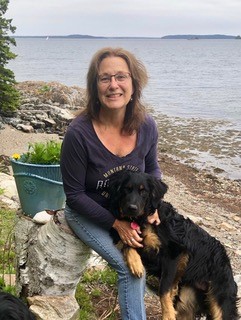
Pat Lindsay-Harvey of Willingboro, New Jersey shares one example of how her community has benefitted from the process:
“Community Heart & Soul made sense because it was very methodical. It had a process, it had a procedure, which has really helped us get more of our residents involved. I can’t tell you how many people are more involved in community because of the Heart & Soul initiative. The people that never have done anything are now going to council meetings, they are filling out the citizen forms to get on committees. It has really helped.”
Pat Lindsay-Harvey of Willingboro, New Jersey
Hear from more Heart & Soul volunteers as they share the most meaningful benefits they’ve seen from the Community Heart & Soul process:
Why Volunteer with Community Heart & Soul?
There are many reasons to get involved with Community Heart & Soul in your small city or town whether you want to steer change in your community, bring in new voices, or share your own perspective.
Star Poole, a volunteer with Heart of Williamsport in Williamsport, Pennsylvania shares, “Having a volunteer position—even a couple months—will show you the meaning of being empowered and having ownership and being productive. A lot of people feel like they are missing something, or maybe there is a lack of something. Maybe your community is missing you, maybe they are missing your viewpoint, maybe they are missing your perspective. All you need to do is get out there and let people know it is there. That is what Community Heart & Soul really taught me.”
Volunteers from Heart & Soul towns highlight motivations for sharing their time and talents with the local Heart & Soul team in the following video:
Personal Gains from Participating in Community Heart & Soul
Volunteering with Community Heart & Soul is personally rewarding!
For Rich Rehman in Hammonton, New Jersey, the personal benefits of volunteering are plentiful. He shares, “It has given me the opportunity to meet new people, to form some new relationships, and make some new friendships through the process. It has also given me the satisfaction and the comfort of knowing that I am helping our community. I’m not just taking from the community, I’m actually giving back to the community, and that is something that is important to me personally.”
Heart & Soul team members from across the country share what they value about the Heart & Soul process and what they’ve personally gained from being involved:
Favorite Things about Volunteering with Community Heart & Soul
While many volunteers share their time with Community Heart & Soul to better their community and themselves, they often stay because the work is enjoyable and gratifying.
Camille Heart is a youth volunteer in Winchendon, Massachusetts. In talking about what she enjoys about the experience, she says, “I love how community-driven the Heart & Soul process is–the flexibility, the commitment of residents, and how inclusive we can make it. There is something in it for everyone—all ages, all demographics, from all walks of life. It is something for the entire community.”
Watch volunteers describe the fun, joyful, and most meaningful parts of volunteering with their community’s Heart & Soul effort:
Why Community Heart & Soul Is a Good Fit for My Time and Talents
Community Heart & Soul offers opportunities for everyone in the community to contribute their skills and voice in some way. In the final video of our Volunteer Voices series, volunteers reflect on why involvement with Community Heart & Soul was a good fit for their time, talents, and interests.
Fawne DeRosia, an artist based in Thomaston, Georgia was able to bring some of her artistic talents and resources to the Thomaston-Upson Community Heart & Soul team. “I was happy to use my talents in any way possible that would help out the Heart & Soul effort. I helped design the logo for Thomaston-Upson Community Heart & Soul. I was very happy to offer up my studio for meetings and brainstorming sessions.”
See ways other volunteers have connected their talents with Community Heart & Soul:
Interested in Volunteering?
There are many ways to get involved with Community Heart & Soul in your small city or town. Use our map to see if there is an active Heart & Soul effort in your community. If not, consider being the spark who excites others to begin the process. Our team is eager to talk to you about ways to get started, and how you can use a Community Heart & Soul Seed Grant to get funding to kickstart your efforts. Contact us to learn more.
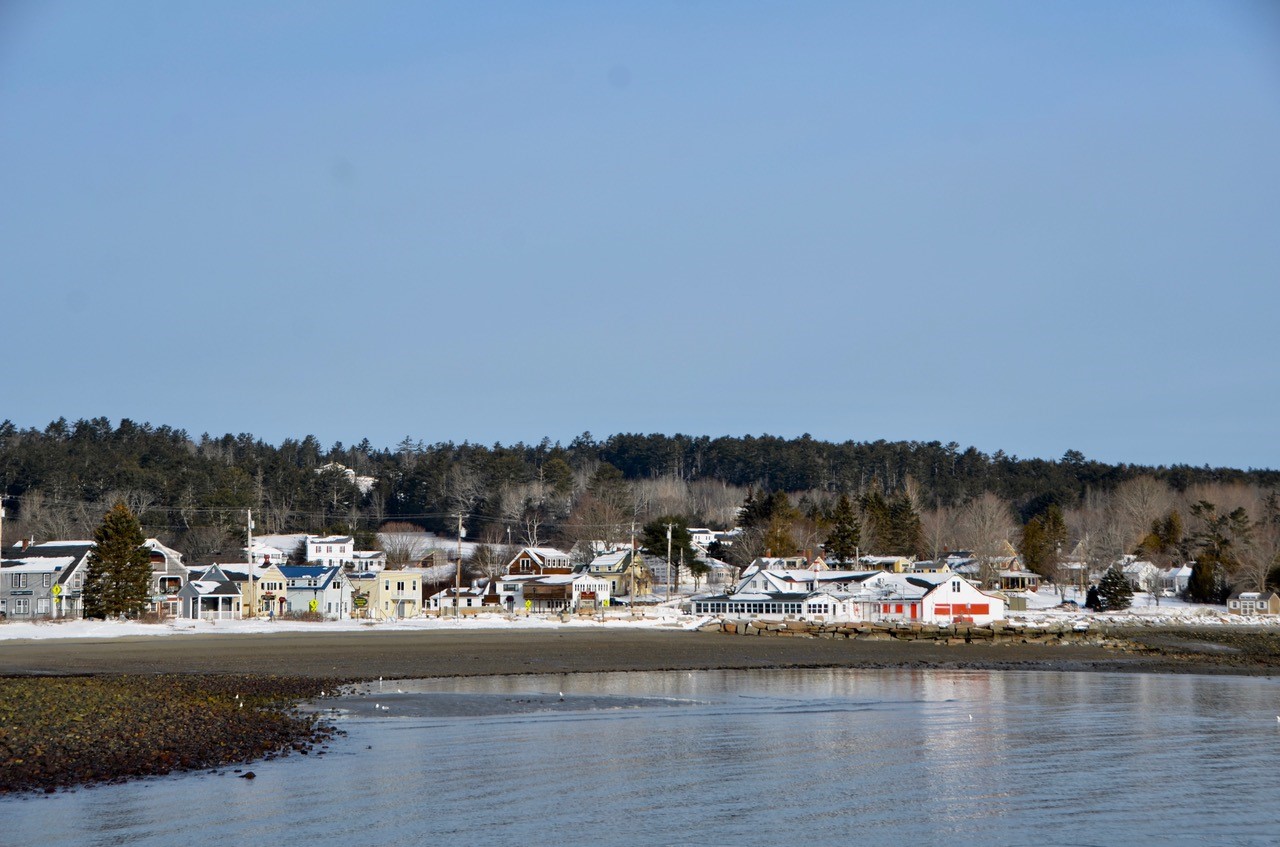
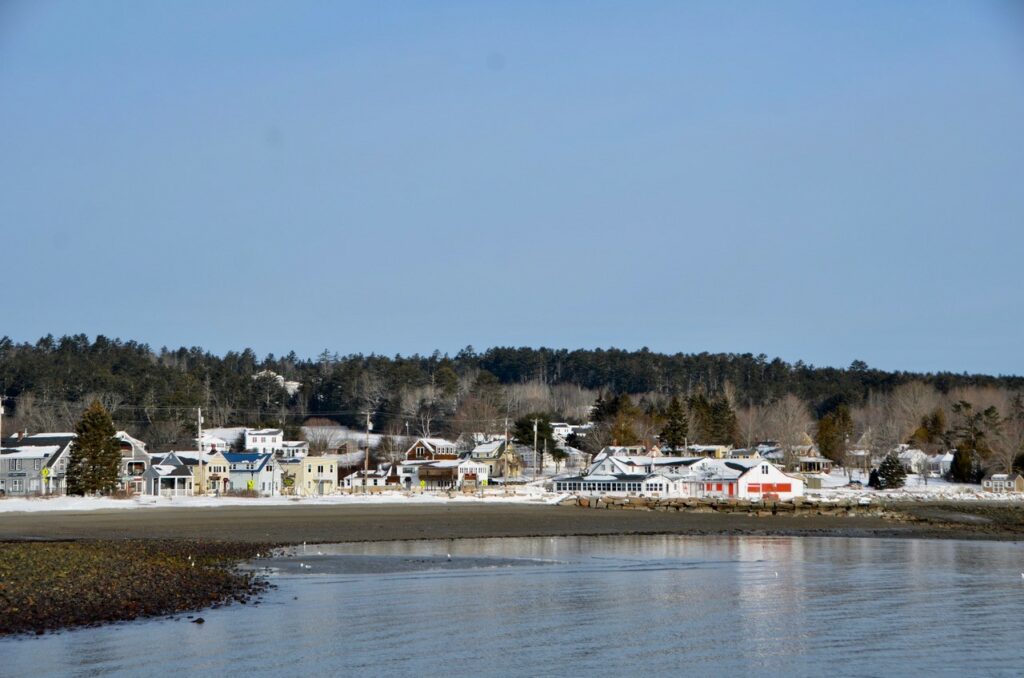
The Town of Lincolnville, on the western edge of Penobscot Bay and almost midway along Maine’s coastline between Boston and the Canadian border, has a strong sense of self. It is small — population approximately 2,312 — and rural, with mostly modest homes and small farms spread through wooded hills and fields, aside ponds or the ocean, or nestled closely together in Lincolnville Center or ‘down at the Beach.’
Lincolnville, Maine. Photo Credit: Lynda Clancy
Lincolnville is rich in history and its people are caring, creative, self-reliant, down to earth, and at times, feisty.
If an issue strikes home, they will likely turn out in force at town meetings. Residents once filled the school gymnasium to debate whether to keep the town’s one-person police department. Filling the bleachers, they stayed put for hours until everyone had their say (and at a close vote, ultimately dissolved the PD).
Lincolnville is a tight-knit community, and neighbors support each other, even if they wind up on the opposite ends of the political spectrum. And they talk. In-person or on social media, they discuss everything from local history and lost pets to checking out the source of mysterious cannon blasts. Columnist Diane O’Brien has written about the community for decades in local media. Recently retired, she handed the column over to her son, Ed, who, without hesitation, picked up the pen to continue the tradition.
Memorial Day parades are solemn affairs led by the Color Guard of local veterans. A June strawberry festival and August blueberry Wing Ding are celebrated with gusto. In early December, wood is hauled to the sandy Lincolnville Beach, stacked as a tall tower, and ignited into a large bonfire. Caroling begins, and the holidays kick off with a flourish.
This is a town that established the Lincolnville Community Library in 2014, after residents hauled an old school house by hand across the street to an empty town-owned lot. They renovated the building and filled its shelves with books. Commissioned as a public library by the State of Maine, a librarian was hired and a mission to foster life-long learning in the community was shaped.
At Lincolnville Beach, six miles from the town’s inland center, the Lincolnville Historical Society continues to raise $325,000 to renovate another old schoolhouse to be the permanent home for an artifact collection, programs and projects that span centuries of local human history.
Changing demographics
For thousands of years, Penobscots made their homes in the woods, and along the shoreline, digging clams in the soft mud exposed by low tides and catching ocean fish; by some accounts, even swordfish that swam up the bay from the open Atlantic.
They fished the Ducktrap River, which today remains one of but six Maine rivers where wild salmon still frequent, swarming from the sea to freshwater in order to spawn.
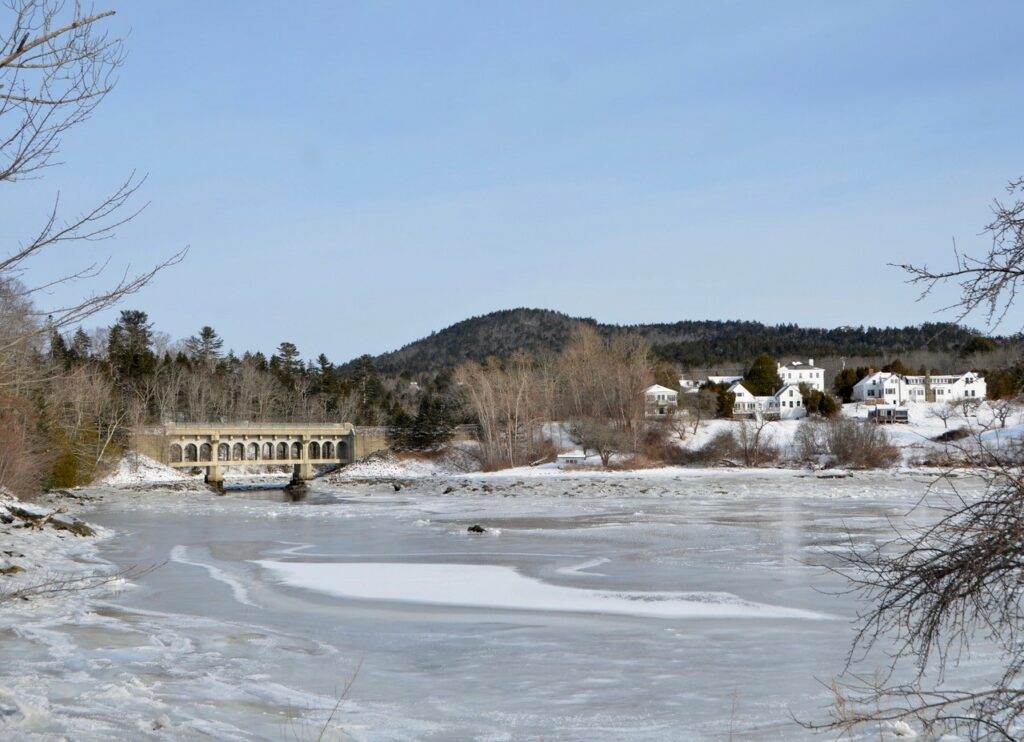
Lincolnville, Maine Scenic Coastline. Photo Credit: Lynda Clancy
Early settlers built their homesteads, and fields were cleared for farmland. Rusticators arrived to build oceanfront cottages, and a wealthy summer enclave on Islesboro, just three miles across the bay from Lincolnville Beach and connected by a state ferry, expanded with fortunes generated during the Gilded Age, and later from exuberant financial markets, Hollywood and Silicon Valley.
The back-to-the-land movement, starting with a trickle in the 1940s, took off in the 1970s and 1980s, with yet another cycle beginning at the turn of the 21st Century. The COVID-19 pandemic further made the Maine coastline, and well inland, an attractive refuge for homebuyers from the North East, Texas and California desiring quieter communities. Home values in Lincolnville shot up over the past several years, as they did in neighboring Midcoast communities, and the population increased, according to some estimates, by 7 percent from 2010 to 2020.
With new people arriving, increased development and shrinking availability of housing, the town knew it was time to take a step back and look at itself, as the forces of change swept in.
In 2021, the Select Board created the Comprehensive Plan Review Committee to update its 16-year-old comprehensive plan. Then, in early 2022, the town agreed to pursue a Community Heart & Soul Seed Grant to help engage residents in shaping its future.
For Mainers, a municipality’s “comp plan” is rooted in the 1970s, when a progressive state planning office encouraged — both by statute and financial incentives — that towns and cities write their own plans, ideally updating them every 10 years. Their purpose is to guide development, town policies and ordinances, especially those governing land use.
“The Comprehensive Plan should not be the work of a few people,” said Lincolnville resident Susan Silverio, who is chairing the 2024 Comprehensive Plan Committee, and is also the local project coordinator for the Heart & Soul process.
“It needs to be the voice of all the people — the young, the elderly who cannot come out to meetings, the students,” she said. “We want everyone’s voice so we can begin to shape the future together, protect what we want and what needs to be protected, and preserve what we have.”
After consulting with the Maine State Planning Office, Susan had suggested that Lincolnville engage with Community Heart & Soul so that the comp plan process could engage all residents to the fullest.
“The more I heard about Heart & Soul, the more I was excited,” she said. “It goes so far beyond the comp plan.”
The Select Board agreed with her, and voters readily approved at the 2022 June Town Meeting to expend $10,000 to match the Community Heart & Soul Seed Grant.
Initial community thoughts
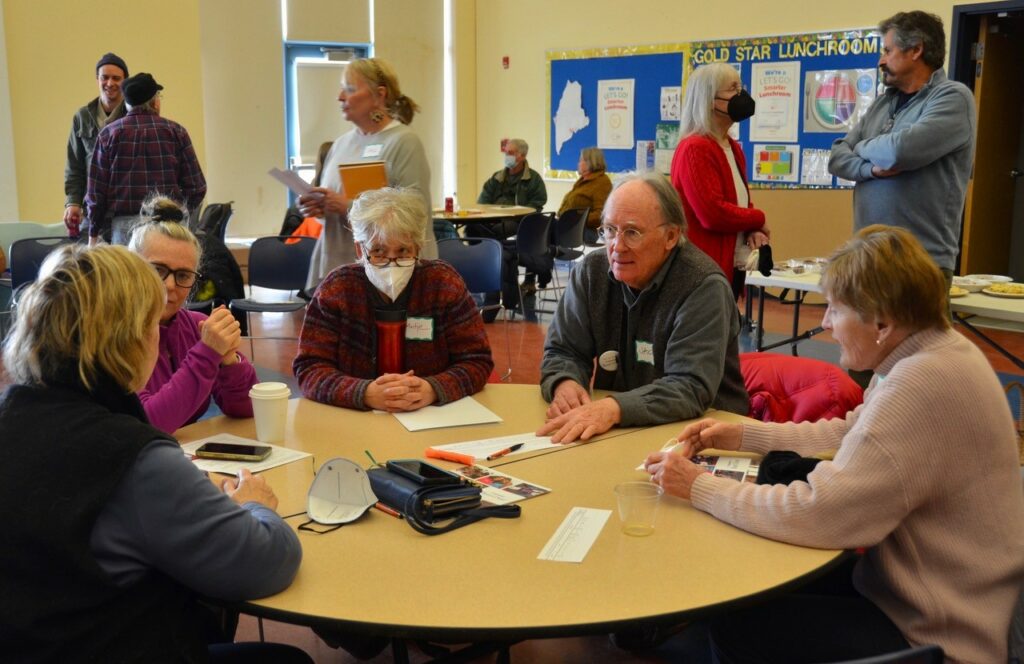
On February 5, approximately 75 residents attended Lincolnville’s first Community Heart & Soul gathering, held in the Walsh Dining Commons at the Central School.
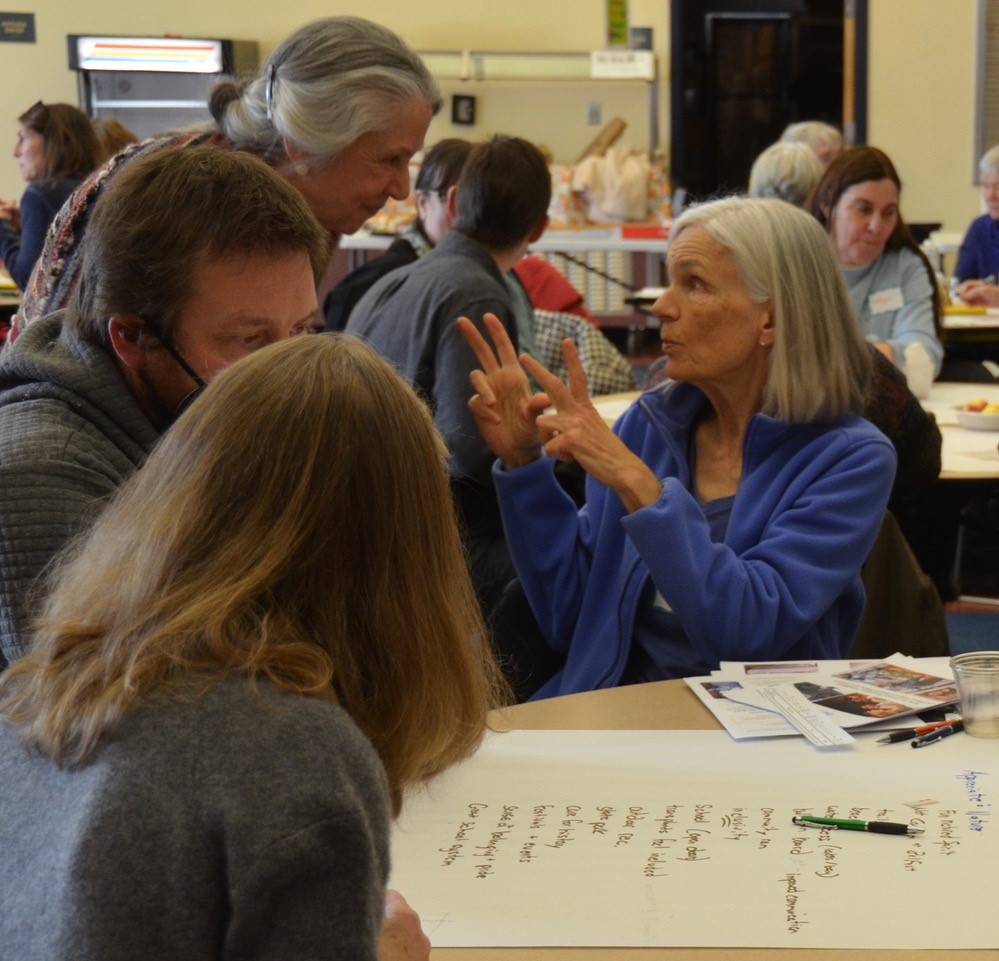
They sat in small groups, five to six people at the most, at round tables, each of them featuring a large pad of paper. Picking up markers, people chatted, some scrawling notes across the pages, others writing in neat, complete sentences. Artists sketched pictures, while quieter folks absorbed the conversations before leaning in with their own ideas.
Residents of Lincolnville at the first Community Heart & Soul gathering on February 5, 2023. Photo Credit: Lynda Clancy
The focus was on imagining a future for their town.
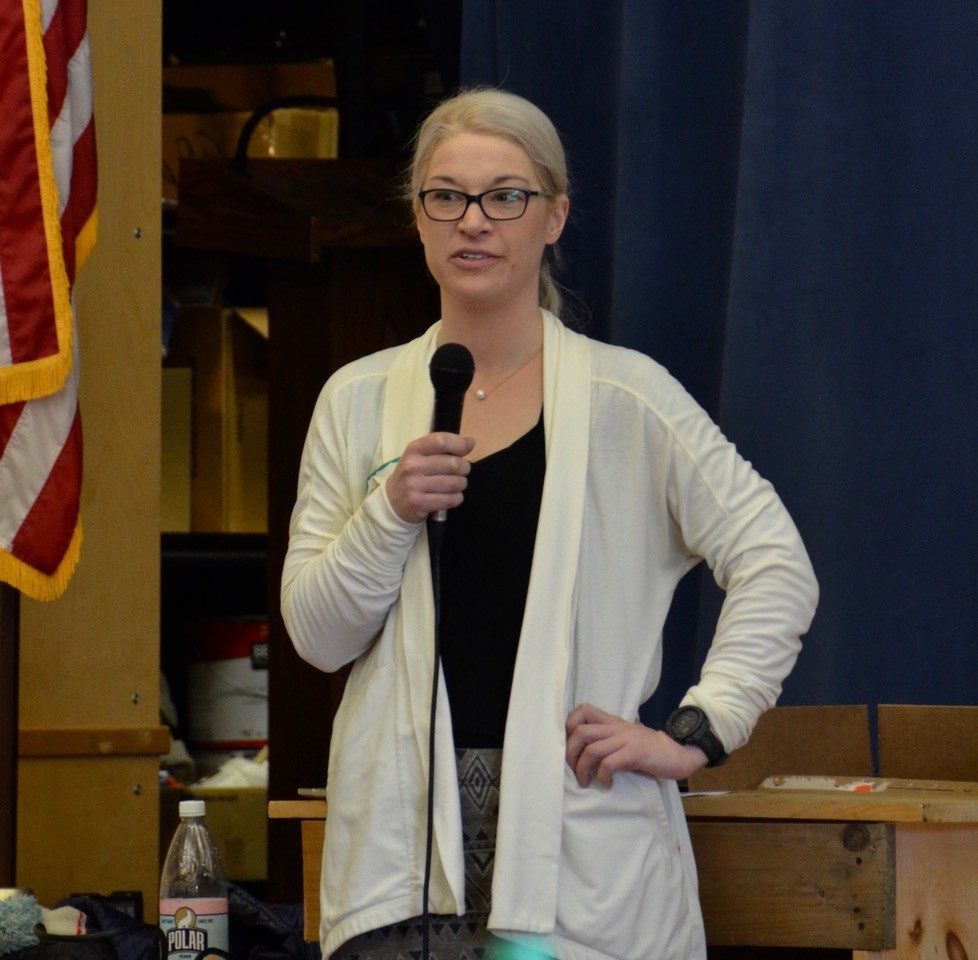
Many who attended were longtime residents and some were new to the community. But it was just a handful who had grown up in Lincolnville; in fact, there were only four who raised their hands when Heart & Soul Coach and meeting moderator Catherine Ingraham asked, “who attended school here?”
Those four ranged in age from teens to elders, and they all earned a big round of applause from the room.
It was a day after record-breaking cold swept through New England, with wind chills of 38 degrees F below zero. Newcomers had gotten a taste for legendary winters of Maine’s past, and old-timers had been reminded of nature’s ferocity.
The meeting kicked off a process focused on collecting, “individual stories, memories, hopes, and ideas that infuse a sense of place and space,” the committee said, in its public announcement.
The next phase, said Heart & Soul Committee members, will be to engage people using, “a wide variety of creative outreach strategies to involve the entire community – lifelong residents and newcomers, year-round and seasonal, young and old, conservatives and liberals, leaders in different areas of the town’s life and people whose voices are often missing or overlooked in community dialog.”
Send teenagers out to interview the elderly in their own homes, suggested one resident, to talk with those, “who do not want to come out and do bigger events.”
As they spoke, handing the microphone to each other, residents touched on common concerns: How to protect open space, natural resources, and community diversity as more people move to Lincolnville. How to cultivate food security with local farms and fishing. How to encourage construction of workforce housing.
Community members at Lincolnville’s first Community Heart & Soul gathering. Photo credit: Lynda Clancy
“What’s going to be here in 40 years?” asked one woman.
There was a fear that the community would put their energy into the Heart & Soul process and produce an updated comp plan, only to find that it would be “shelved.”
That is Susan’s concern, as well. She looks forward to the stewardship team that is to emerge after a plan is approved, which ensures that the collective wisdom of the community identified during the Heart & Soul process continues to guide future town planning.
“I’m hoping that one of the outcomes is more people getting involved on municipal committees,” she said.
“The process is going to reveal information that the town can use and move forward,” said Lincolnville Town Administrator David Kinney, who has been at the town’s helm for 20 years. “Separately from this, on parallel tracks, the Comprehensive Plan Committee is doing data gathering to update some of the information in the existing plan, because you have to know where you are before you figure out where you are going.”
At Lincolnville’s first Community Heart & Soul gathering, Feb. 5. Photo Credit: Lynda Clancy
“This,” he said, nodding to the residents chatting around the tables, “is going to help the comprehensive plan effort in understanding where we want to go.”
As Heart & Soul steering group leader, Lincolnville resident Cindy Dunham remarked in an announcement of Heart & Soul: “What I love about this process is that it’s so positive. The focus is on identifying the areas of agreement among residents about what they hope Lincolnville can be like in the future, and then developing ideas for moving toward that future.”
One woman, who is new to Lincolnville and had no intentions of speaking publicly, strode to the front of the room and said simply: “Everybody has the same concerns. Everybody loves their family, home, and community. We all care, and need to find things we can agree on. If we don’t talk with each other, we can’t change our minds and come to solutions for what our community needs for the future.” To learn more about the Heart and Soul process in Lincolnville, visit the dedicated Facebook page: Heart and Soul Lincolnville
Want to bring Community Heart & Soul to your town? Apply for a $10,000 Community Heart & Soul Seed Grant to get started. Learn more at: www.communityheartandsoul.org/seed-grants
Lynda Clancy, Author
Lynda Clancy is editorial director of the Penobscot Bay Pilot, an online community hub that covers a large region of coastal Maine. The beauty and complexity of small towns have inspired her as a writer and photographer since the 1980s. An award-winning journalist, she serves on the Maine Press Association’s Board of Directors, the Maine Legislature’s Right To Know Advisory Committee, as well as local community nonprofits and municipal committees.
Residents, coaches, reporters discuss local-level community revitalization initiative at Jefferson Educational Society Global Summit event.
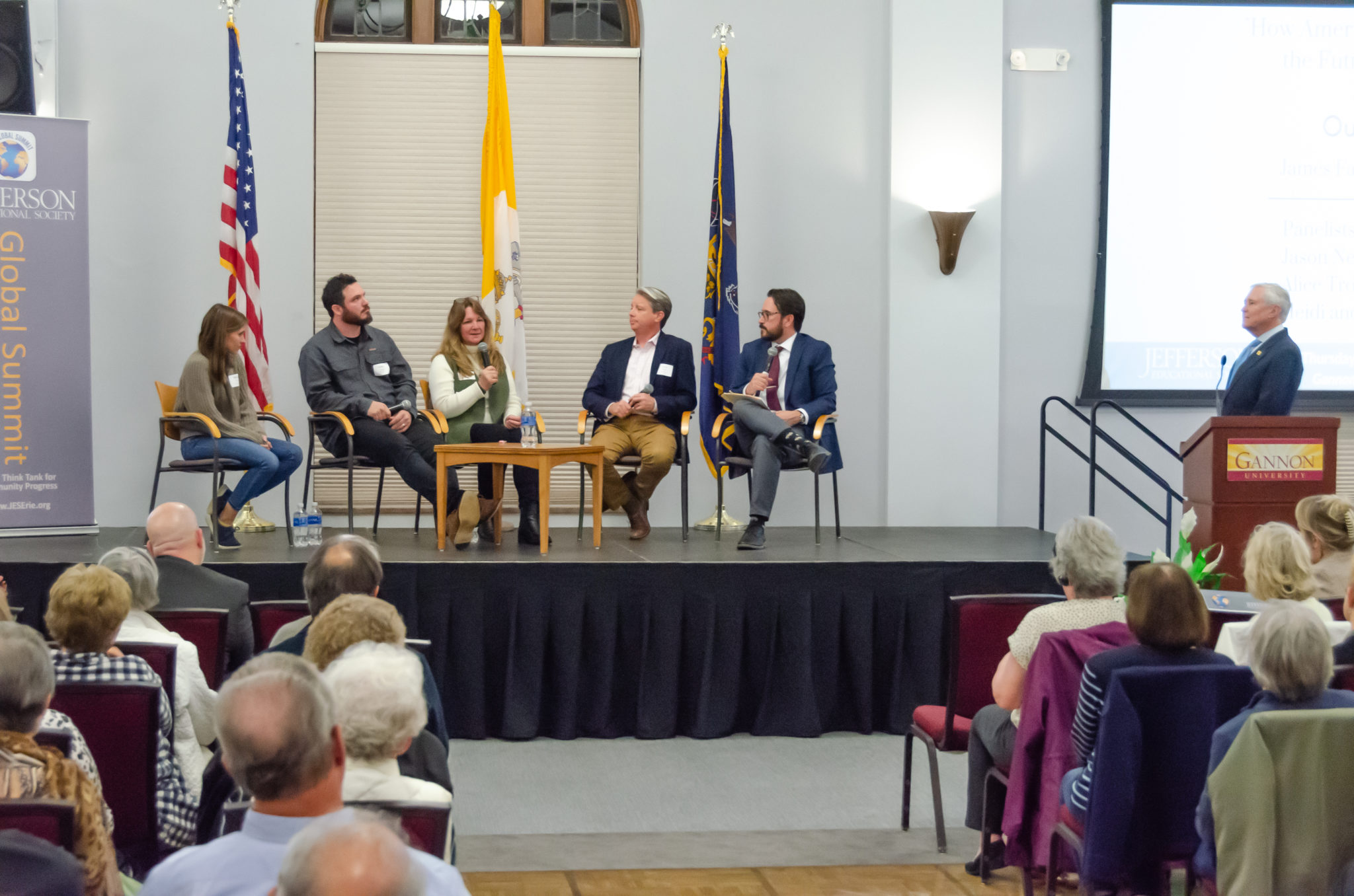
On Thursday, Nov. 10, 2022, in Erie, Pennsylvania, the Jefferson Educational Society, in partnership with Our Towns, hosted “How America’s Towns are Writing the Future of the Country” during the think tank’s annual Global Summit — an event series that I have been a part of since 2015 aimed at bringing big ideas to a smaller community. It is now available to stream on-demand, and I have embedded the video below.
But first, some context-setting about what you’ll see and hear: The event features opening remarks from Our Towns’ co-founder James Fallows, followed by a panel discussion I moderated featuring Jason Neises, the Community Development Coordinator at the Community Foundation of Great Dubuque; Alice Trowbridge, a contractor with PA Humanities; and Isaac and Heidi Tucker, residents of Dillsburg, Pennsylvania.
The thread weaving the panel together? Community Heart & Soul, a resident-driven community development process, which we’ve reported on often on this site (and is a partner and supporter of our work).
In his opening remarks, Jim discusses the origin of the ongoing Our Towns journey, noting that the story of America as often shown on cable news and as often told in national headlines contrasts what can be seen often playing out from neighborhood to neighborhood at the local level.
From afar – the national observation – the United States appears to be divided, as our differences are pronounced, playing out in high definition, and written in large, bold font. But focus in on the local level, and you’ll see that “all around the country, at times of national-level distress that we’re so familiar with, there is this diaspora of people trying their best and people coming up with new ideas, and the potential of another reform movement taking shape,” Jim told the in-person crowd of some nearly 300 attendees at Gannon University as well as those tuned in virtual to the live stream.
One example of a process for how people are working to improve their towns, addressing challenges with opportunities and resources, is the Community Heart & Soul process. The how happens at various levels – from the residents, to volunteers to project coordinators, to coaches, as I discuss with Alice, Jason, Heidi, and Isaac.
Also in those opening remarks, Jim, when discussing the “Our Towns” HBO Documentary, notes the power of video to capture in seconds what might take a writer a thousand words to do.
In the spirit of that observation, with which I much agree, I’ll skip over lengthier analysis and commentary, but will share just a few things to listen and watch for:
1 — How the Community Heart & Soul process creates an inclusive community development process, helps build capacity for nonprofits, cultivates emerging leaders, establishes local and regional identities, and more.
2 — Why storytelling plays a powerful role in shaping the future of towns.
3 — How civic leadership can connect with residents in authentic, meaningful ways – like gathering around a grill full of hotdogs.
4 — What’s to be gained by creating a space for the youth to be, to be seen, and to be themselves.
5 — Why being 18 has more to do with an 18-year-old leaving any given town than the town itself, but why intentionally creating a place that 18-year-old who left years ago might return to matters more than trying to never let them leave.
5 1/2 — How a lot of gears driving community progress are greased with craft beer.
As a bonus, a rough-and-ready transcript is available on the Jefferson Educational Society’s YouTube channel. You can follow along – with the awareness that it contains typos and will differ in some word-by-word details from what you may hear for yourself. The time-stamp numbers you see cue to portions of the video.
As Jim concludes (which sharing here does not spoil the watch but should rather only further encourage it): “The country is full of creativity and insight, and that is something that the country needs to know about itself.”
So, whether you were in the room as part of the in-person audience, or tuning in via live-stream, or haven’t yet watched or listened to this program – I encourage you to stream it on-demand now here:
“How America’s Towns are Writing the Future of the Country,” Jefferson Educational Society Global Summit 2022.
A train depot that’s a museum. A former bank branch building that’s become a library. Another former bank that is serving as an early education center. Here is how this South Carolina town is repurposing buildings of the past to build up its future.
After a week-long trip through North Carolina and South Carolina in late August, I wrote about initial takeaways Michelle Ellia, my Our Towns colleague and fiancée, and I had here.
What we found, I wrote, was “different from what we expected when we began the trip, and a lot different from what you would expect if your only window in North Carolina and South Carolina is the national news.”
We saw, and will write about, different themes in different towns: Residents addressing the environment and sustainability topics in interesting and creative ways; a pronounced impact of both local and regional nonprofits along with national organizations supporting these communities at the town level; and how new ideas were breathing new life into old spaces.
This dispatch is about Kershaw, South Carolina, and the way it is using old places for new purposes.
Vestiges of Kershaw’s past remain in and around the South Carolina town.
In the 1820s, miners discovered gold just three miles outside of town on some 20,000 acres owned by Benjamin Haile. Production out of Haile Gold Mine, described locally as “the largest gold mine east of the Mississippi,” has ebbed and flowed as the mine has changed ownership over the years. It helped fund Confederate war efforts; it was sacked by Sherman’s troops; and as gold is being mined today, it is now the focus of environmental and sustainability efforts—as we’ll describe in upcoming reports.
We drove into Kershaw from the north, and saw the hulking, still-active Archer Daniels Midland soybean processing facility with its still-in-use railroad tracks. Those tracks serve as an ever-present reminder to residents and visitors alike of the area’s founding. In 1887, the Southern Railroad established Welsh’s Station on the Charleston, Cincinnati, and Chicago Railroad. A year later, the town incorporated.
This story is about residents who are excited to tell us about their town’s future, and show us that vision in the present, rather than longing for bygone eras. We saw that the new things were happening in old spaces. We also saw the impact of Community Heart & Soul®, a resident-driven community development initiative we have reported on before, in bringing the town together, and addressing critical issues in imaginative ways.
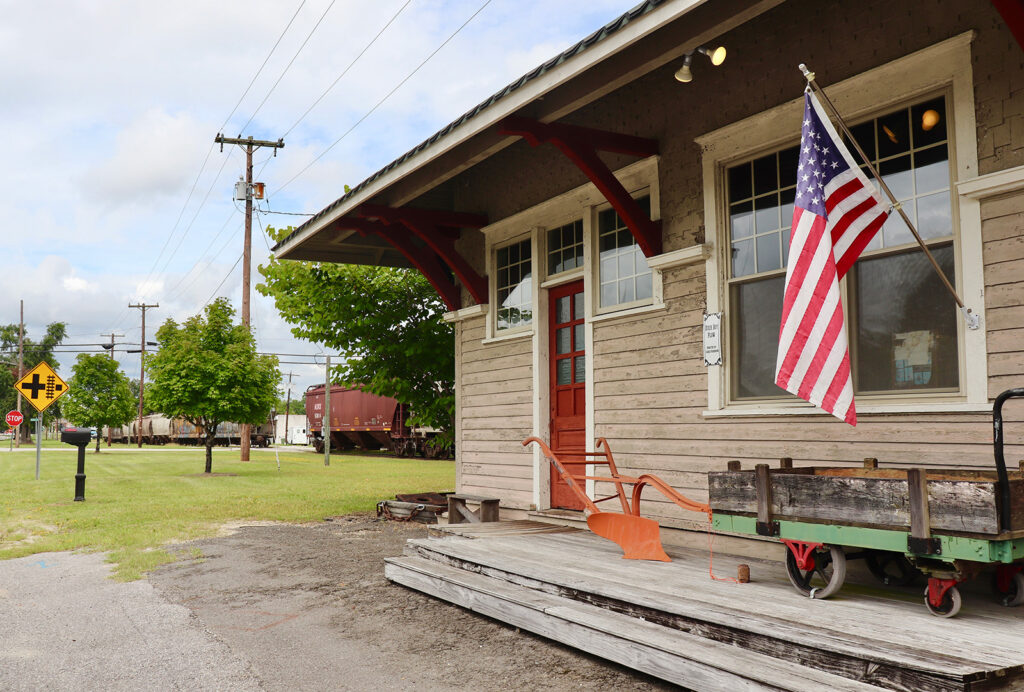
Today in Kershaw, gold mining and railways intersect on North Cleveland Street. Just one block off Hampton Street, the main street in the town of some 2,000 residents, Kershaw’s old rail depot now serves as both office space for the mine’s latest owner and operator, OceanaGold, and a museum housing both mining and railroad memorabilia open to the public.
Built in 1926, the Kershaw Depot, listed in the National Register, replaced the prior depot, which had been struck by lightning and destroyed in a fire. The current structure served as a terminal for both freight and passengers for nearly two decades until the Southern Railway sold it in the mid ‘40s. After, it lived several different lives, at times housing a craft shop, then a florist.
The Kershaw Train Depot is now office space and a museum. Photo by Michelle Ellia.
In 2010, the Haile Gold Mine purchased the property, saving it from demolition and preserving the interior woodworking. Renovations kept most of the original structure intact. Although it wasn’t open the day we were there, we were told that many of the artifacts inside have been donated by residents or were items found at the Haile Gold Mine site.
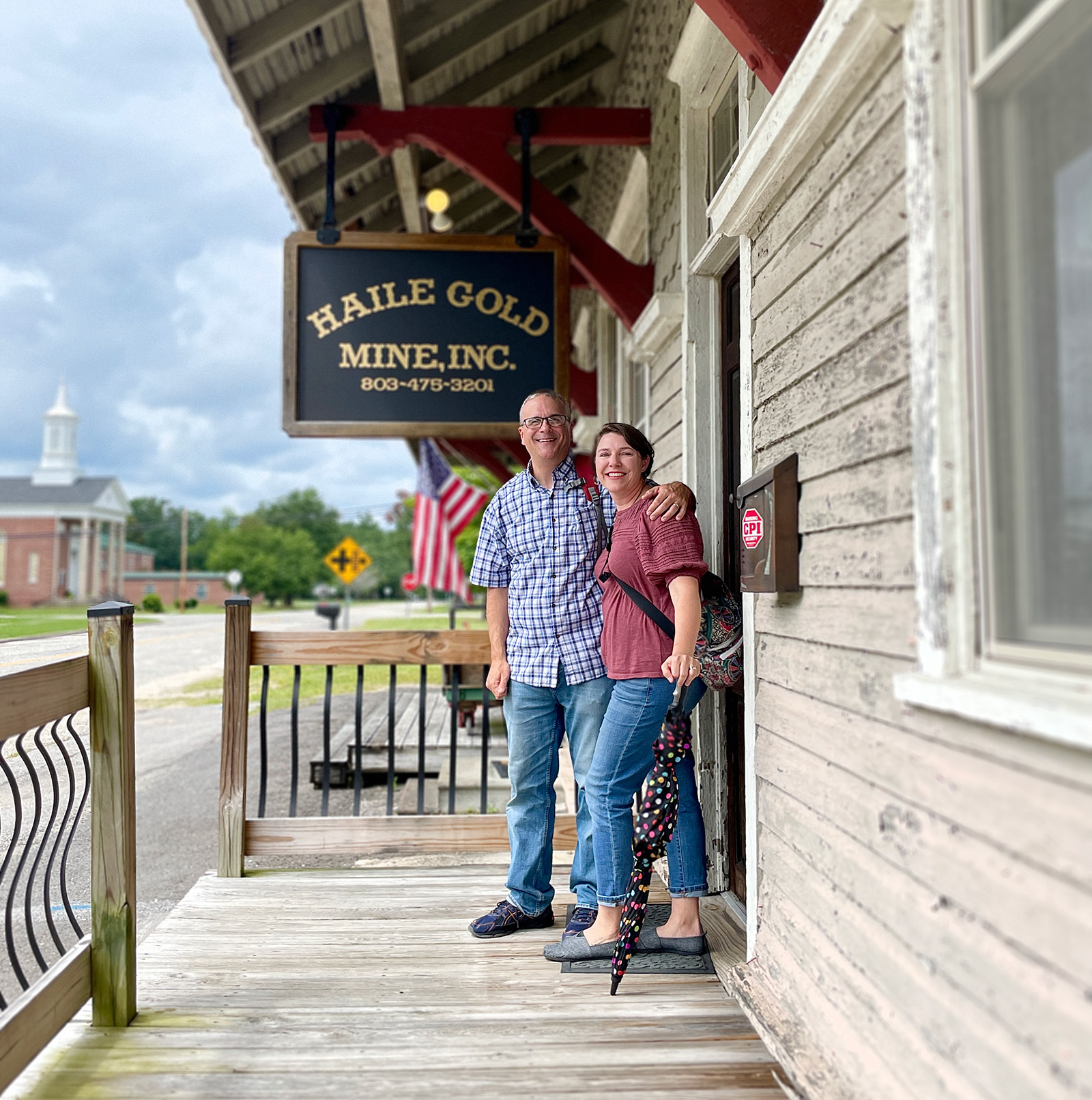
Standing in front of the then-depot-now-museum, Tiffany and Scott Whaley, who co-own and co-run their small business, Grassroots Advisors, and are heavily involved in the Kershaw Area Resource Exchange (KARE), brought up another part of South Carolina’s past that continues to cast a shadow into its present: The collapse of the textile industries.
“It was devastating,” Tiffany, who grew up in the rural southern part of the state and moved to Kershaw with Scott, her husband, in 2006, told us.
“That speaks to towns as big as Greenville in the Upstate, all the way down in Low Country in Charleston,” Scott, who grew up in Greenville, added. “But it was particularly hard on small towns, because in bigger towns there were other options. But in smaller towns, it was textiles. Everything was textiles. And once that left it, it was devastating.”
That word stayed with us. Not devastating, but was.
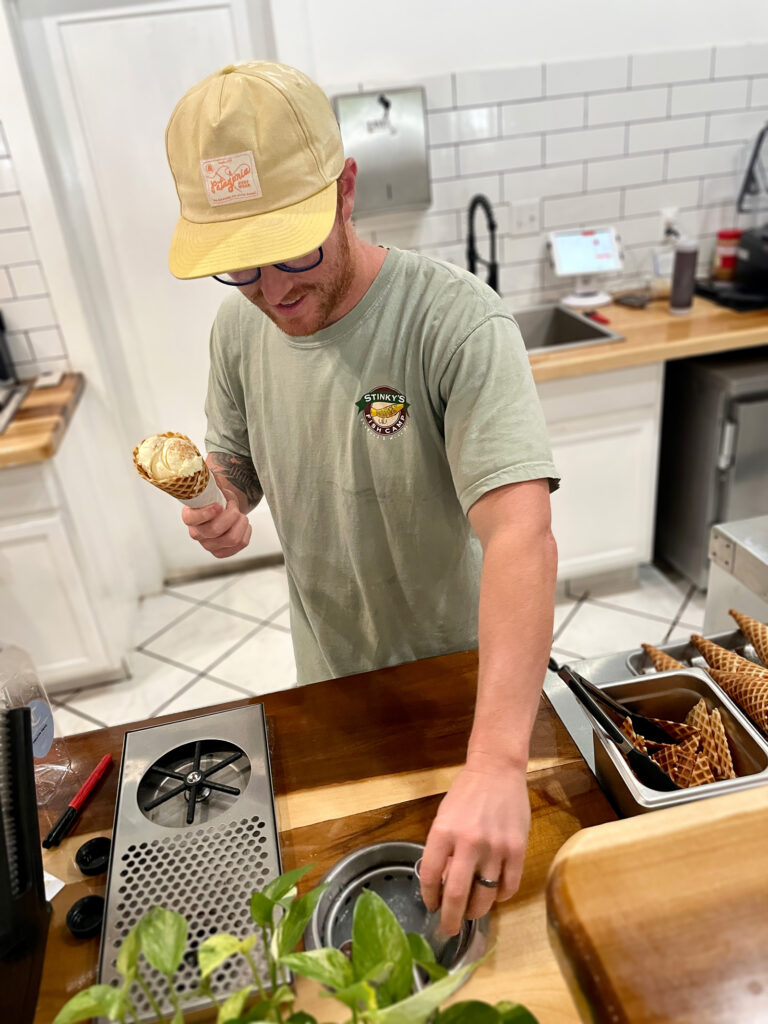
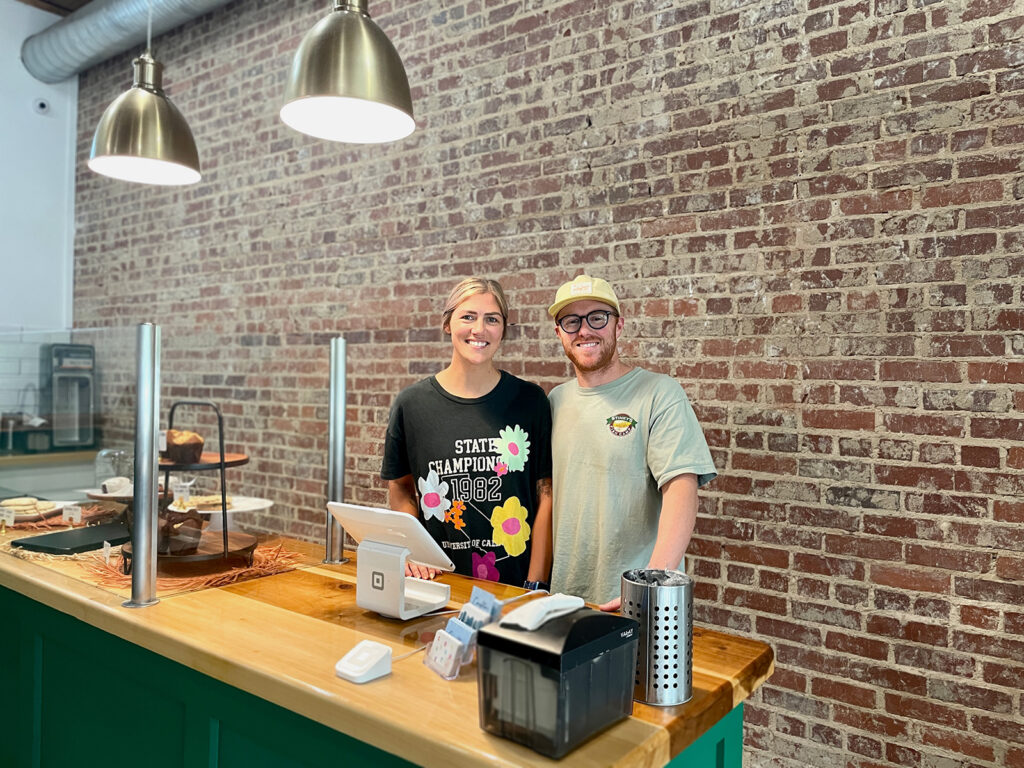
Walking up and down Hampton Street with the Whaleys, we saw a downtown with storefronts along its main street at near capacity. We tasted the successes of Creighton’s Creamery, a boutique ice cream shop and staple of the downtown core, run by a 31-year-old Cady and 29-year-old Adam Eubanks, another wife-husband duo working and living together in Kershaw. The couple started the business as a food truck that became so successful that they launched into a brick-and-mortar location where they also sell coffee made by a local roaster.
Adam Eubanks, owner of Creighton Creamery (Photo by Michelle Ellia)Cady and Adam Eubanks owners and operators of Creighton’s Creamery, named after their son, converted their ice cream food truck into brick-and-mortar space along Kershaw’s main street. Photos by Michelle Ellia.
When I asked them why they were building their business in Kershaw, they asked me: “Why not?” adding, “Kershaw is home. This community supports us – why would we go somewhere else?”
The majority of their business comes from the some 12,000 people living in the encompassing 29067 ZIP code, Cady told me. Adam added that they rotate their flavors weekly so that their regulars don’t tire of their offerings. The couple told us they just purchased another building several blocks south, and were exploring ideas for another business along the main street stretch.
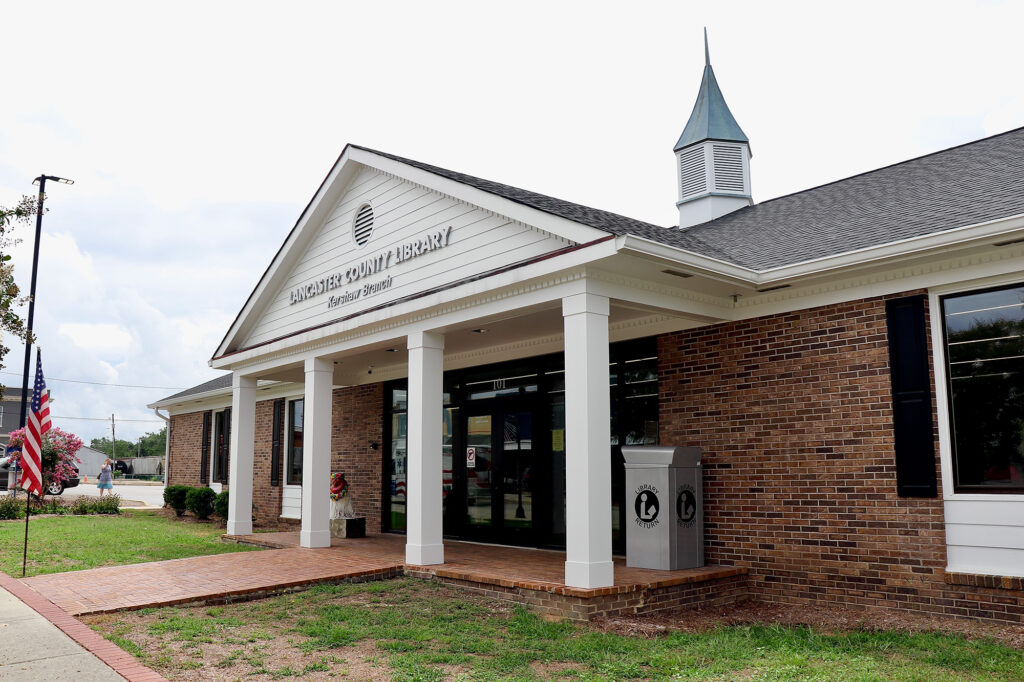
Across the street from Creighton’s Creamery is the Kershaw Branch of the Lancaster Public Library. From the outside, it looks like a standard one-story bank branch building, because that is what it used to be. Wells Fargo owned the building until 2017, when it closed that branch along with hundreds of others nationwide.
Lancaster County purchased the former Wells Fargo branch, and relocated the town’s library to its main street. Photo by Michelle Ellia.
Then Lancaster County purchased the building. So began the plan to move the library branch from its shared space with other municipal resources just outside of the downtown to the standalone structure in the heart of the town. The doors of the brick building reopened anew in spring 2021.
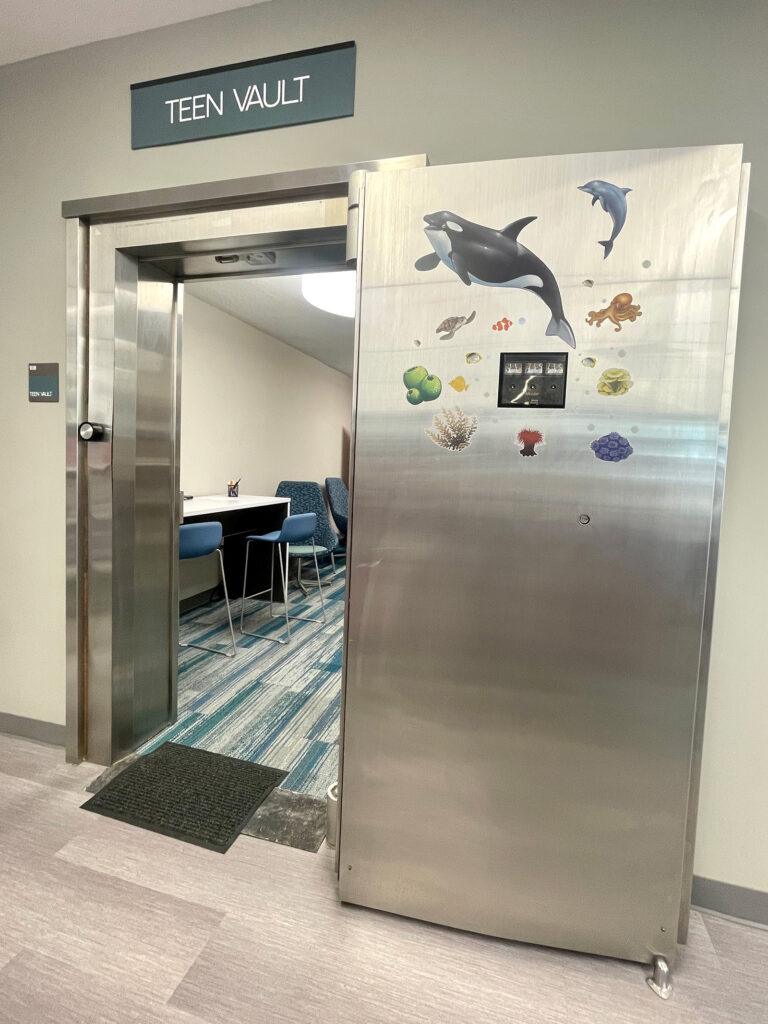
Inside, the Teen Vault caught our eyes first. Rather than remove the bank’s vault, the county left it intact, and the library staff created a space for teens to gather to browse the young-adult collection, watch DVDs, and jot out ideas and leave messages to each other on a whiteboard. We’ve seen the emphasis, the intentional planning around teens in libraries elsewhere throughout the country, like here, and here, and here.
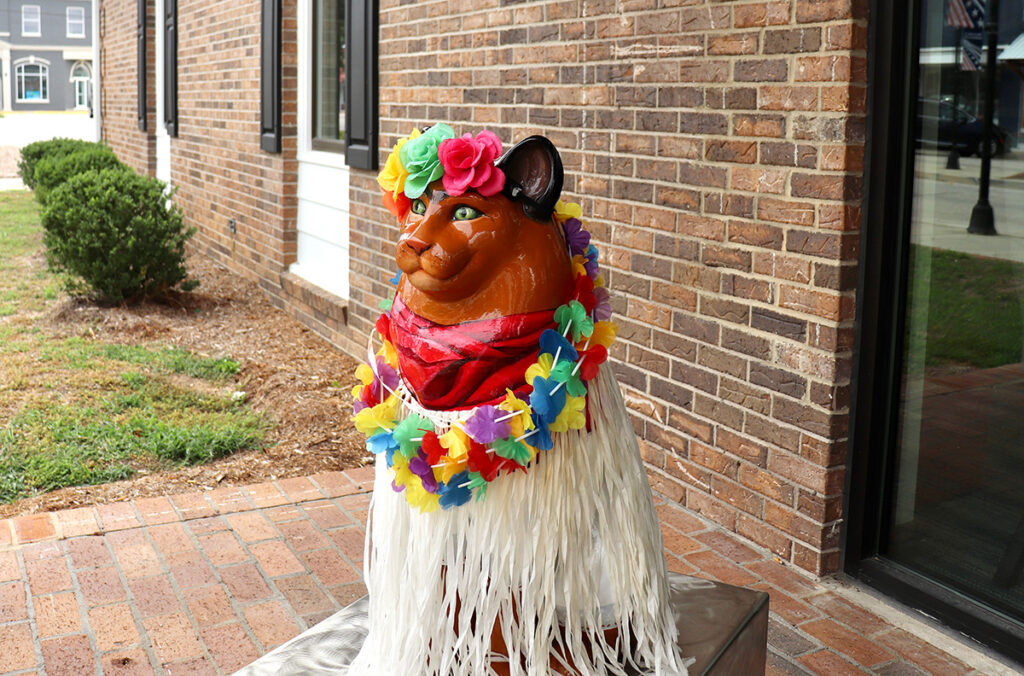
The bank vault remains, now serving as a space for teens. Photos by Michelle Ellia.The Lancaster County Council of the Arts launched a creative placemaking initiative that led to statues of dogs and cats (like the one seen here outside of the library) throughout the county. Photos by Michelle Ellia.
Outside the library, we noticed a lei-adorned cat statue. A few months ago, the cat wore sunglasses, Tiffany told me. As the seasons change, so do the outfits. The statues of both cats and dogs popped up throughout the county as part of a Lancaster County Council of the Arts creative placemaking programming program funded by the Arras Foundation, Cynthia Curtis, the foundation’s community investment officer, who joined us as we toured the town, told me.
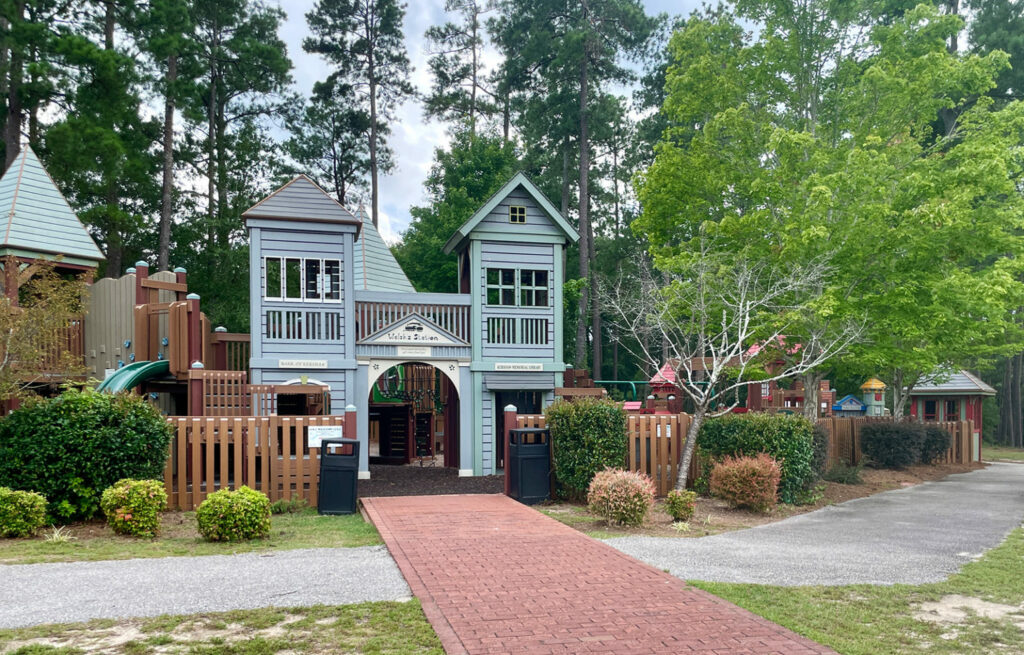
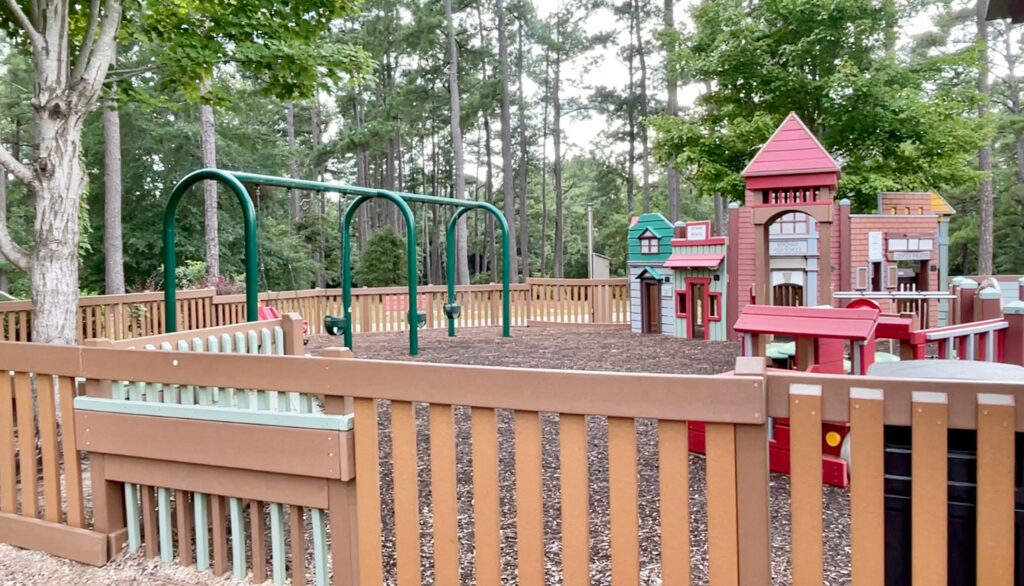
The foundation’s investment is evident elsewhere in Kershaw, like at Stevens Park. There, the foundation collaborated with other local and regional partners, including the Kershaw Park Community Council and the town, to improve the walking trails to connect the park’s amenities, like spaces where the youngest citizens can gather to play, an outdoor amphitheater, a skate park, and even a swing set designed for Kershaw’s older residents so that grandparents who were looking to bring their grandkids could have playground equipment they, too, could use.
How did people in Kershaw decide to reinvest in left-behind buildings, rather than tearing them down or leaving them vacant? The answer is inevitably complex. But we heard that an important part was a process we’ve reported on from many communities. This was a collaboration involving a local-area foundation, in this case the Arras Foundation; the residents of Kershaw; and the Community Heart & Soul® process, which is designed to foster community cooperation on the values most residents share. (Community Heart & Soul is a partner and supporter of Our Towns reports.)
About seven years ago, the Arras Foundation was considering how it could help small communities in its area, like Kershaw.
“The Board and I were starting to think together about how to do authentic community engagement to listen to the needs of people. We knew we needed a process that brought the voices and needs of the people to the table,” Susan DeVenny, president and CEO of the foundation, told me over dinner in nearby Lancaster, where the foundation is located, later in the week.
Stevens Parks, located on the north end of Kershaw, features spaces for residents of all ages. Photos by Michelle Ellia.Stevens Parks, located on the north end of Kershaw, features spaces for residents of all ages. Photos by Michelle Ellia.
Shortly after those conversations began, Susan attended a conference in April 2016, where CH&S leadership was presenting, and found the model intriguing. After six months of discussions and strategic planning with CH&S, Arras brought the resident-driven community-development process to South Carolina. In 2017, Kershaw, along with nearby Fort Lawn, turned to Community Heart & Soul®. They were the first two South Carolina towns to adopt the Heart & Soul process.
There will be more to say in later reports about the Arras Foundation’s impact in and around Lancaster County. In Kershaw’s case, it provided the funding and resources for the Heart & Soul process, including deploying Cynthia as a CH&S Coach.
The local CH&S team in Kershaw, which includes the Whaleys, conducted over 1,300 surveys and gathered some 200 stories throughout the 29067 ZIP code. That data – what residents valued about their town, what they saw potential in, what challenges persisted – led to the seven Heart & Soul “values” Statements focused on local businesses, environment, culture, development, education, faith-community harmony, and small-town feel. One of the proclaimed “positive changes in the community” cited: A new library in the middle of downtown in the old Wells Fargo Building.
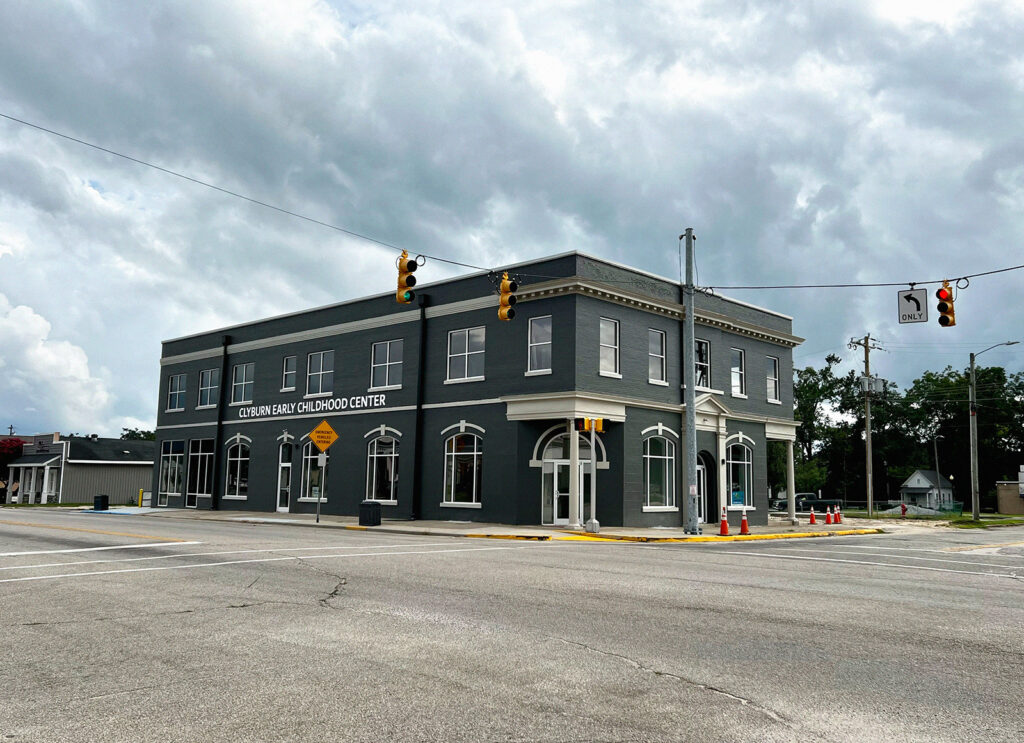
“Small town, big heart,” is how Mitch Lucas described Kershaw to me later in the afternoon standing a few blocks south on Hampton Street in front of the soon-to-be-opened Clyburn Early Childhood Center, in yet another reborn structure.
Vacant for four decades, the former Bank of Kershaw building has been transformed into the Clyburn Early Childhood Center. Photo by Michelle Ellia.
Mitch, a retired educator and former Town Manager who now calls himself a “worker bee,” was involved early in the Kershaw Heart & Soul initiative like the Whaleys. Like them, he has continued working on projects leading out of the Statements, including the development in the former Bank of Kershaw building.
Built in 1910, the building featured the bank on the first floor and a range of offices – from optometrists to insurance agents – on the second. It became vacant in the late ‘70s, and sat that way for some 40 years.
The Community Heart & Soul process had revealed a critical issue facing the town: Kershaw was in the middle of a childcare desert.
So, the town put together a grant application in November 2019 to South Carolina First Steps, which the state’s General Assembly established in 1999 to narrow the educational readiness gap. Kershaw received $600,000 in May 2020, and renovations began shortly after the announcement. In August, the project received additional support, as the Arras Foundation awarded a $350,000 grant to support the second phase of the project. The Town of Kershaw leveraged this grant for additional funding resources.
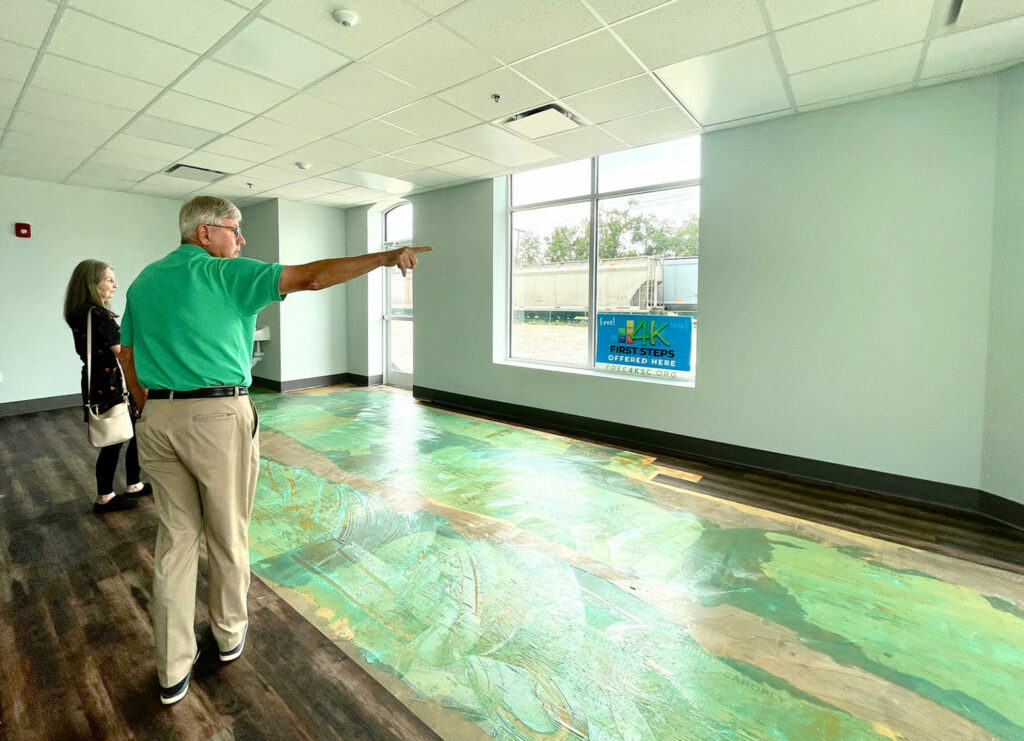
Mitch Lucas (right) shows Cynthia Curtis where an open space will soon become a playground at the Clyburn Early Childhood Center. Photo by Michelle Ellia.
Mitch guided us through the 10,000 square-foot building, named after a former mayor, William R. Clyburn, Senior, from whom the town purchased the building at a reduced rate. On the first floor, we saw three classrooms – one classroom for three-year olds, and two for four-year olds – getting the finishing touches when we were there so that they would soon welcome Kershaw’s youngest residents ready to learn.
There was the soon-to-be kitchen space to feed the youngsters during the day, and the parent-teacher room where staff would help “teach them how to be their first teachers,” Mitch told me. The extended day (from around 7 a.m. to 5:30 p.m.) and extended year (230 days, rather than the more standard 180) will be free of charge to families that qualify, Mitch said.
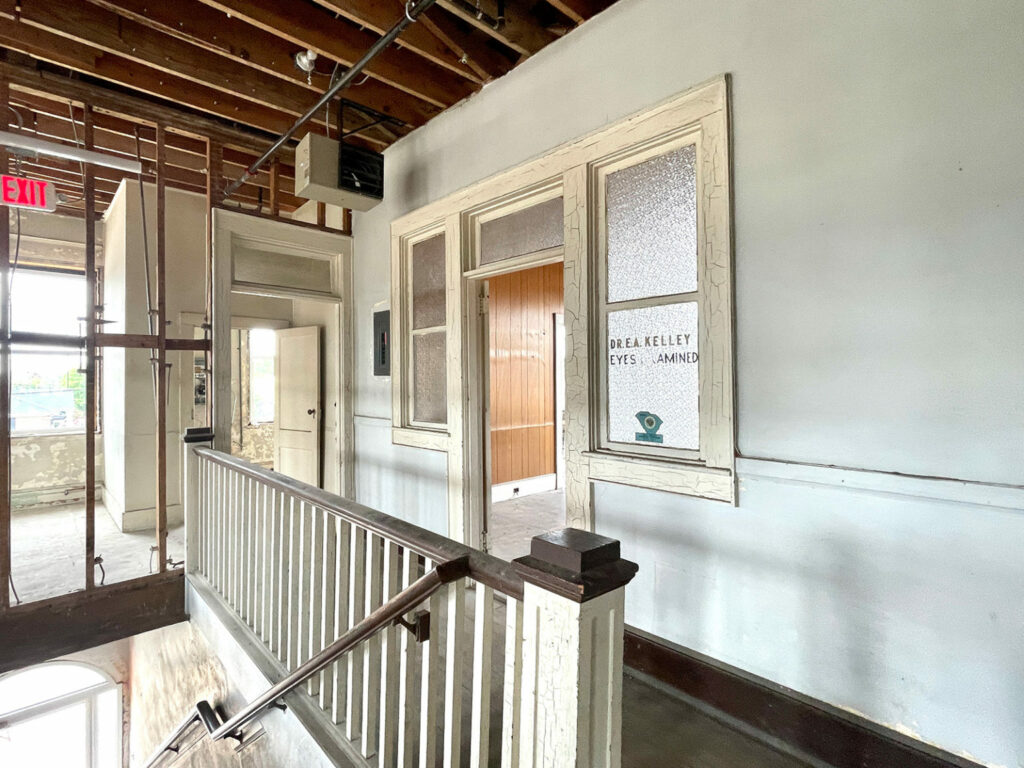
Following Mitch up the dusty staircase to the second floor, we imagined how the first floor looked before the renovations. Layers of dust. Cobwebs strung out in the corners. Cracked paint peeling around doorways.
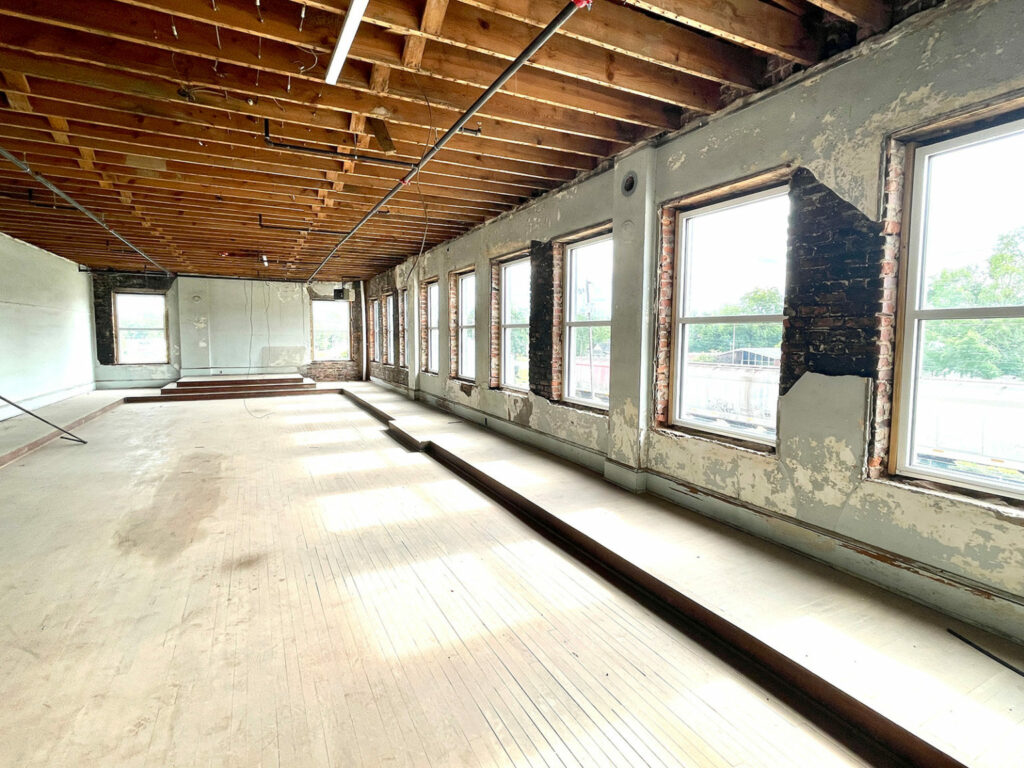
The second floor of the Clyburn Early Childhood Center once housed various offices and featured larger rooms for community gatherings. Photo by Michelle Ellia.The second floor of the Clyburn Early Childhood Center once housed various offices and featured larger rooms for community gatherings. Photo by Michelle Ellia.
Still much as it had been for some 40 years, it presents as the blank canvas with plans drafted to serve as a community center, Mitch told us. Former offices, like the one where his uncle sold insurance, reimagined as computer labs and meeting and event spaces.
For that, funds have been secured from South Carolina’s Capital Project Sales Tax, or “Penny Tax.”
“We put together a grant, and Heart & Soul was all my presentation,” Mitch told me.
From the outside, Kershaw’s buildings – a train depot, two bank buildings – tell the story of the past. But inside – a museum, a library, and an early education center – they tell the story of the town’s future, being written presently by its residents.
Growing up in small-town Ohio, I often used water towers as a compass, my version of celestial navigation. Driving across farmland from town to town, you see the towers looming, many of them with a city name or civic slogan, reassuring you that you’re on the right country road and heading in the right direction.
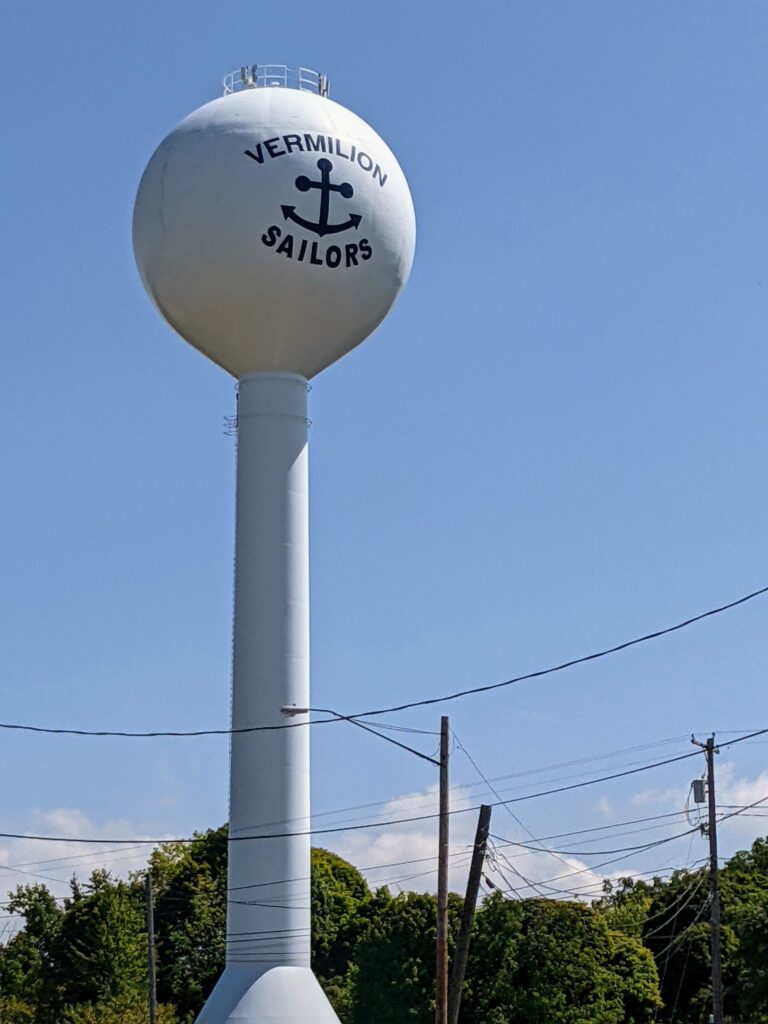
My hometown of Vermilion sits on the south shore of Lake Erie. Its classic globe-shaped water tower is planted near the railroad bridge that spans the river. Bold dark letters, VERMILION, arch over the top. The image of an anchor secures the middle. The word SAILORS arches underneath it. Sailors, as you could guess, is the mascot for the Vermilion High School teams.
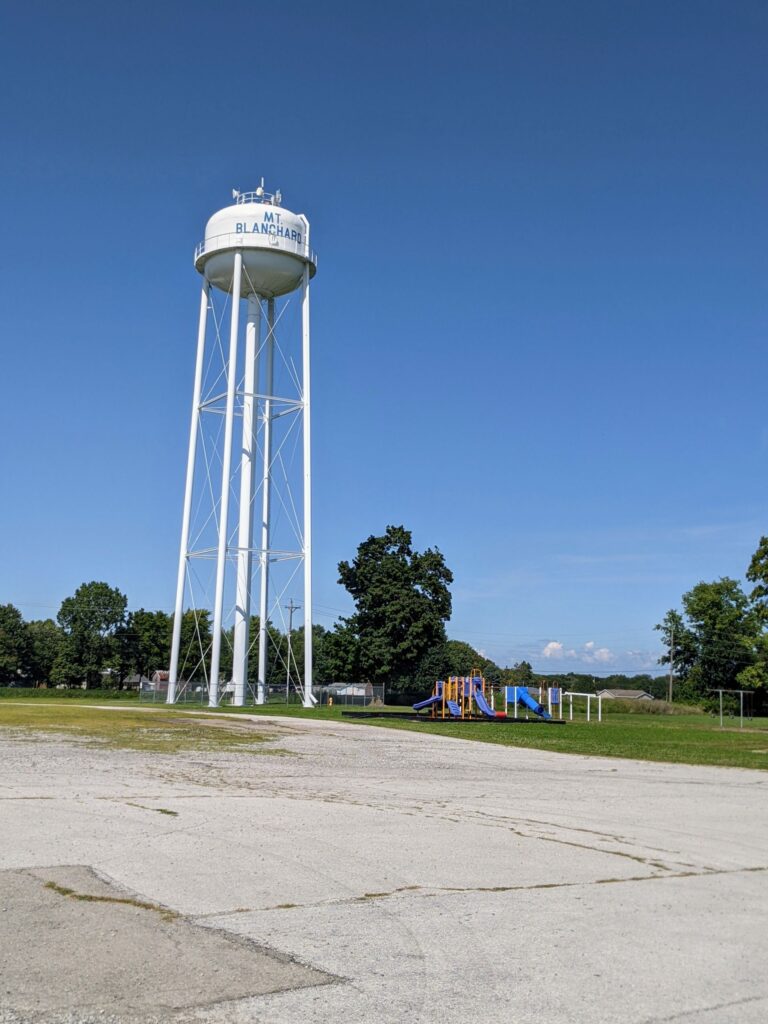
Fast forward to well beyond high school as Jim and I were driving this summer through farmlands in northwest Ohio, heading for Mount Blanchard, a town of 500 people about 60 miles south of Toledo. We passed crossroads that lead to more small towns and more farmland. We judged our approach as we caught sight of the water tower of Mount Blanchard. The tower, we learned later, was a proud and critical addition to the town’s infrastructure improvements made years earlier.
Vermilion, Ohio: “Home of the Sailors” (Photo credit: Deborah Fallows)Mount Blanchard Water Tower (Photo credit: Deborah Fallows)
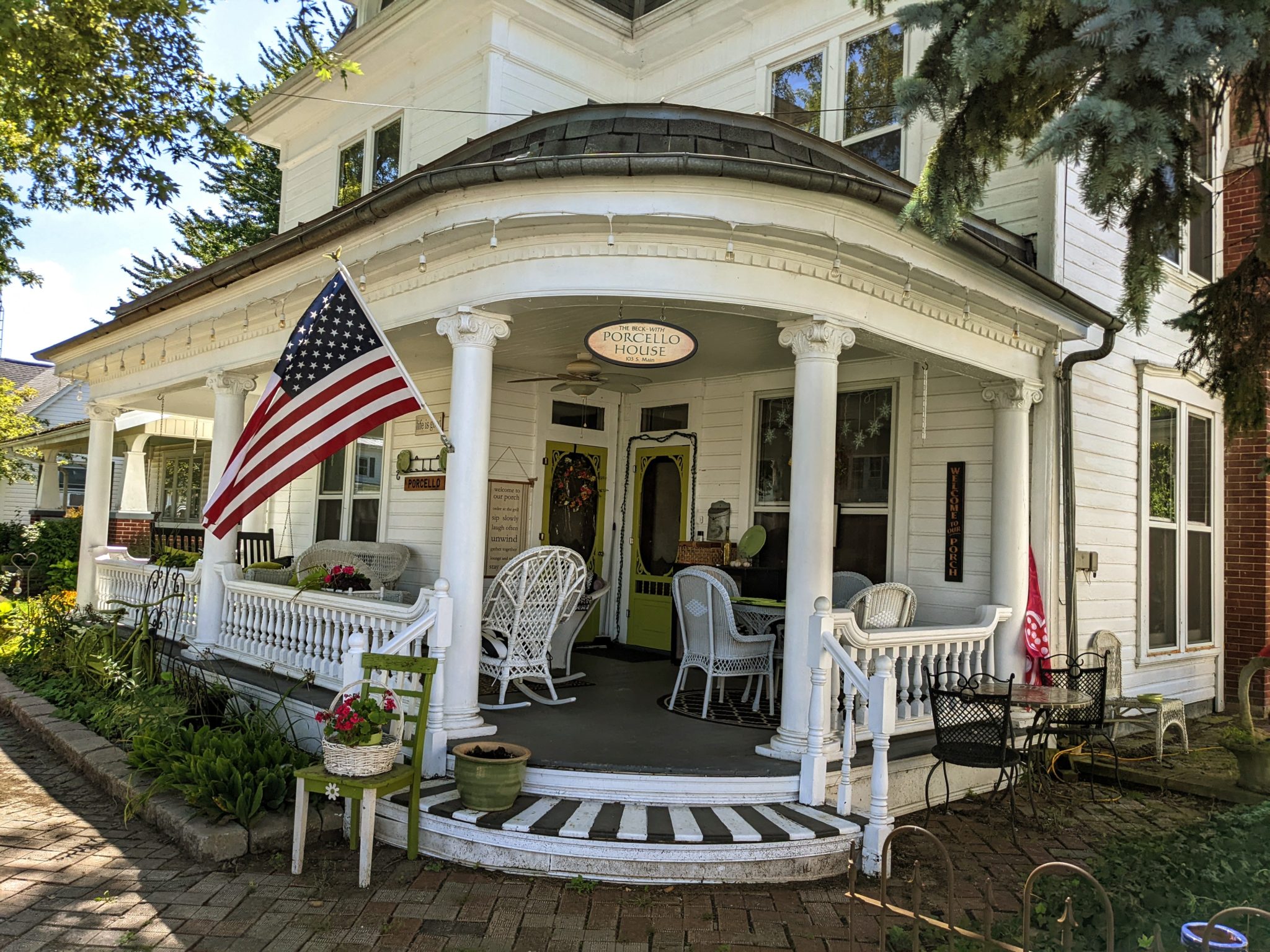
We heard that there was a lot more to Mount Blanchard than its major improvements and its street-level classic Midwest charm, and that this town was a model for change, much of it community-driven. We found Jackie Porcello, a dynamo of civic energy, on the big wraparound porch of her Main Street Victorian house to hear the story.
Mount Blanchard approached change in two ways. One was through various government grants for big-ticket items like the new water tower, the sidewalks, street lamps, a gazebo, and the less-sexy sewer lines. A second approach was to adopt a resident-led, citizen-involved process called Community Heart & Soul® (CH&S), which we had seen in practice earlier in Maine, southern Pennsylvania, Illinois, and South Carolina (upcoming). We were impressed before, and wanted to see more. (Community Heart & Soul is an Our Towns partner and supporter.)
After a few hours rocking on the front porch, Porcello suggested we zip around town in her golf cart for an illustrated version of her stories. We drove past the familiar inventory of sites: the cemetery, the churches, the mayor’s residence, the house where Porcello grew up, the site of the former school. Curiously, a boast of many towns about churches is having more of them per capita than any other town in the country; we heard that in South Carolina, in California, in Ohio (several times), and elsewhere. Who knows? There was also a marker to Johnny Appleseed, who once owned property and planted apple trees in Mount Blanchard.
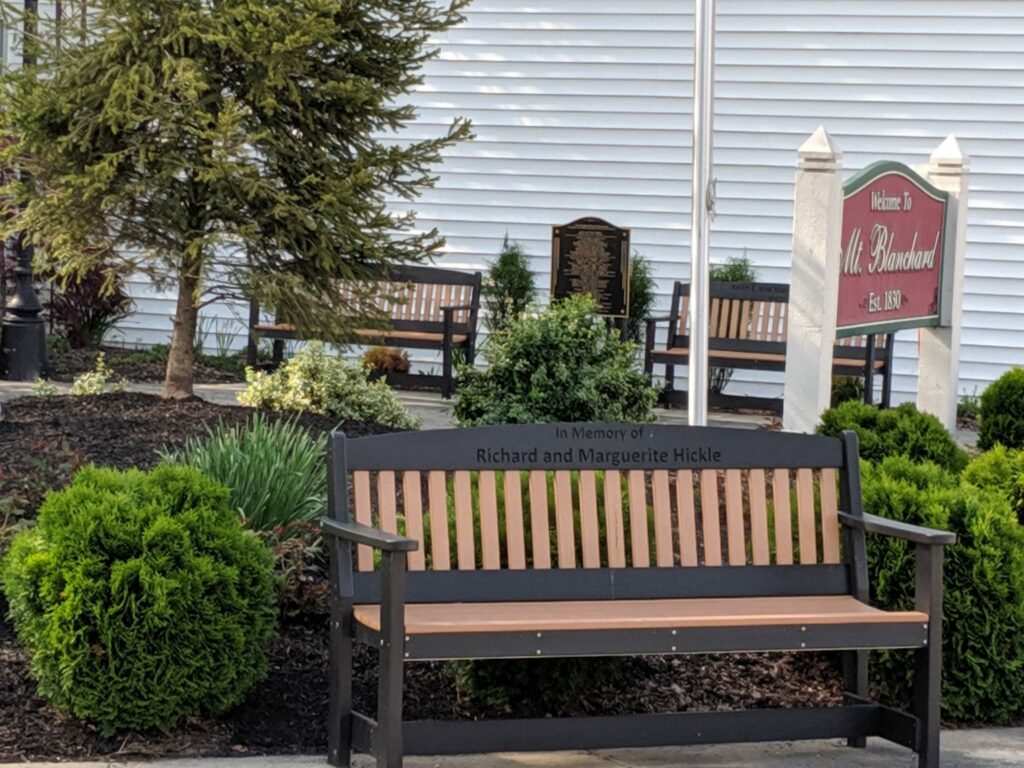
Benches and marker in Mount Blanchard’s Veterans Park (Photo credit: Jackie Porcello)
We walked around Hurricane Park, named for the original school mascot, with its late-summer landscaping and gazebo in the foreground of the new water tower. Along the park’s edge was a most unusual, surprising digital rotating LED sign. Such signs catch your eye. There is one that I studied with interest when we lived in Shanghai that offered a moveable feast of time, date, temperature, number of available parking spots in various lots, and the decibel level of passing traffic.
The LED sign in Mount Blanchard was somewhat controversial, since it is so bright and green and seems out of character in its surroundings. But as Porcello described, the sign’s great benefit is as a source of information, especially in a town with no local newspaper. The sign keeps residents abreast of events like the schedule for the farmers market, or the upcoming community lunch for kids before the first day of school. It stands right on Main Street, in sight of everyone in town going anywhere, or of outsiders passing through who might be interested in local happenings.
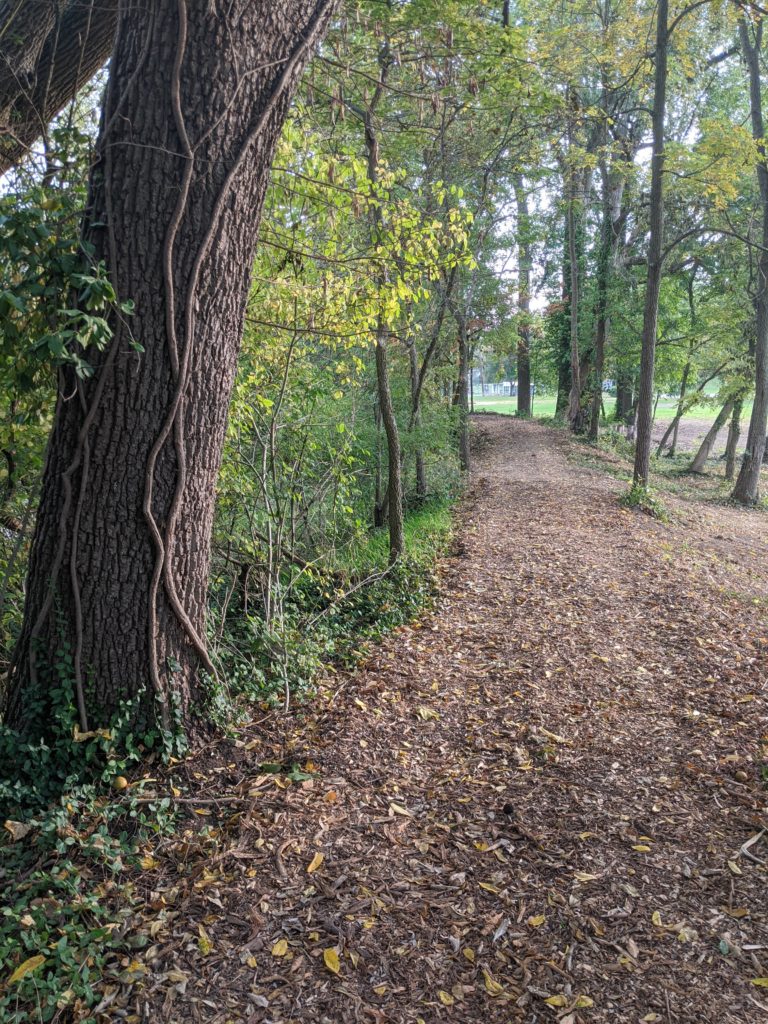
Along the Heritage Trail in Mount Blanchard (Photo credit: Jackie Porcello)
Three particular points of town pride caught my attention: the public swimming pool; the surrounding sprawling recreation area called Island Park; and the Heritage Trail, a hiking trail in development, which meanders through downtown and over to the river. We have seen such quality-of-life improvements in towns that speak to top-of-mind issues, like keeping young families happy, and serving as a drawing card for potential new residents, and as a dedicated gathering place for the youth. We’ve written about river walks in countless towns and cities, which has led to a favorite family mantra, “Every successful town has a river walk, even if it doesn’t have a river.” Mount Blanchard’s “river walk” was proving the point once again.
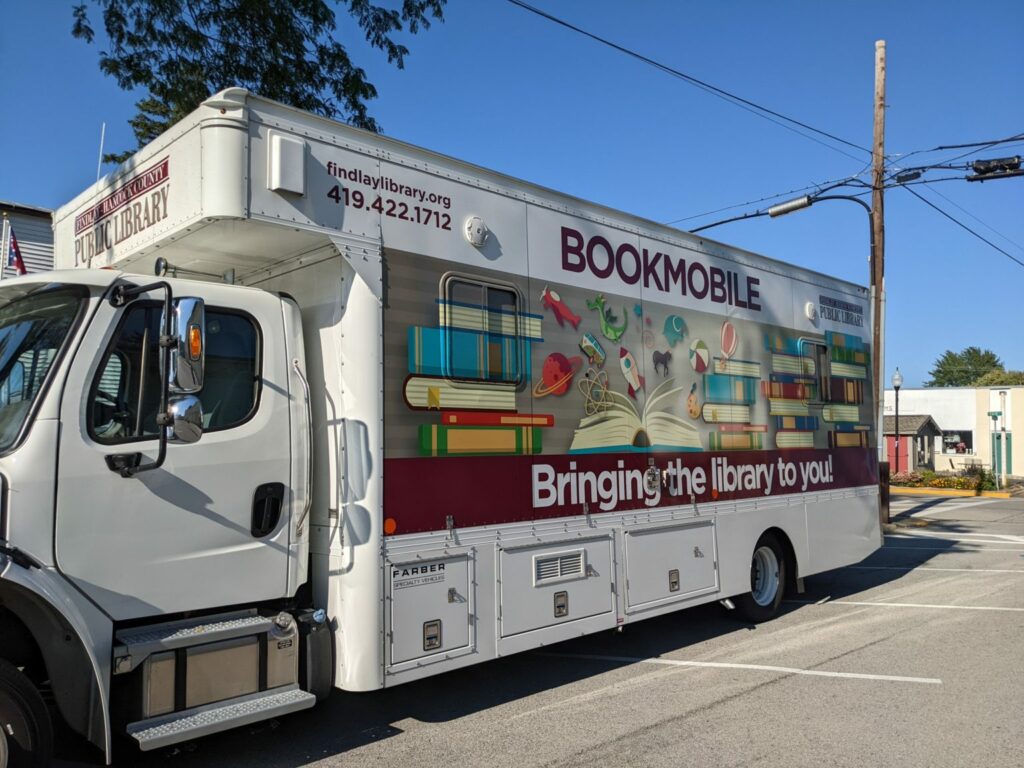
Downtown Main Street looked like a work still in progress: some shops were boarded up; others were abandoned. Here used to be a grocery store; there used to be a bank. But changes were also notable. On one corner was a small pop-up park and across the street another landscaped park with flagpoles and a veterans memorial marker. During our visit, I spotted the Findlay-Hancock County Public Library’s colorful bookmobile, on its weekly visit to Mount Blanchard. Sarah Clevidence, the library’s director, told me about the bookmobile, an old-fashioned but effective way to reach rural communities that didn’t have their own libraries.
Bookmobile from the Findlay-Hancock County Public Library (Photo credit: Deborah Fallows)
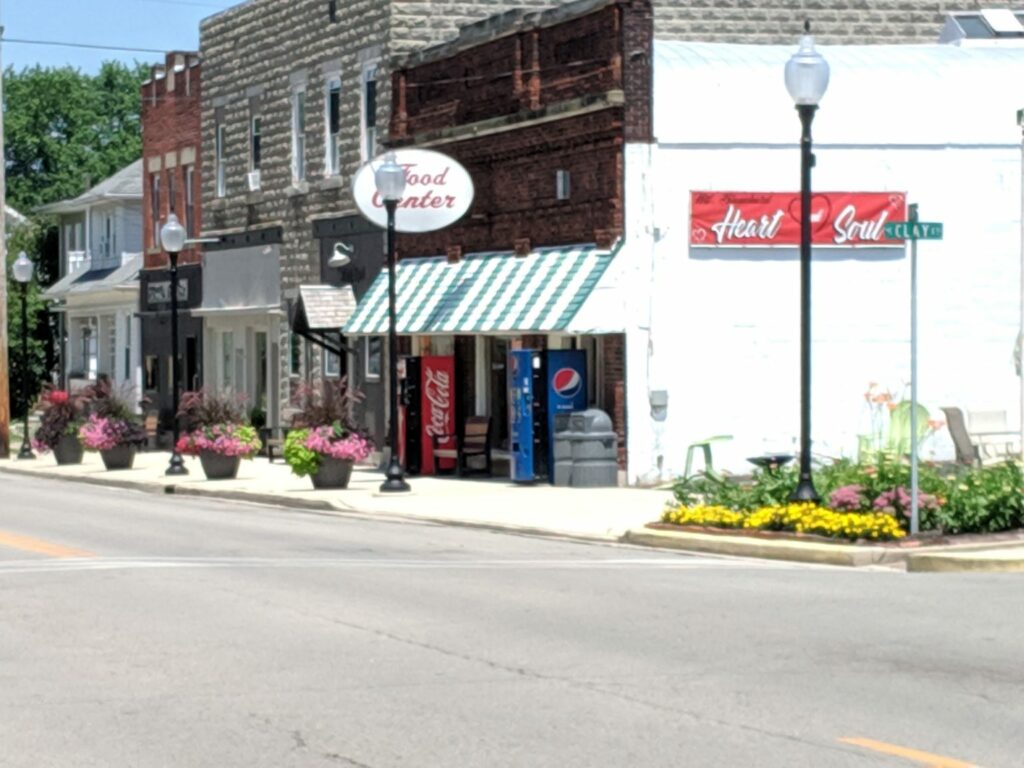
Some upgrades, like the Main Street flower planters, benches in honor of community residents, and a shop’s new green and white canopy, seemed to have a more personal touch. In Mount Blanchard, going small had big payoffs. Jackie Porcello said she thought the reasons might surprise us: “Small improvements and changes might not be noticed in a big busy town, but smallness has attributes. When there’s a new bench in town, everyone notices. That wouldn’t happen in a big town. But here, it’s a big deal.”
Main Street in Mount Blanchard (Photo credit: Jackie Porcello)
Porcello and another dozen Mount Blanchard residents explained to us that many of these improvements were the fruits of their CH&S project, a democratic process that engaged the town citizens for ideas, decisions (actual voting!) and taking action.
Here, briefly, are the steps that Mount Blanchard citizens took:
Build a team: A small, core group in Mount Blanchard signed on to do the work. They applied for funding from the Findlay-Hancock County Community Foundation (FHCCF), which had committed to many lift-all-towns efforts in their county, including CH&S funding for three rural towns. Community foundations are a story for another day soon, but the teaser is that we have seen the personal approach and support from community foundations help fundamentally recharge the economy and culture of the towns and regions they serve. The funds in this case would pay for CH&S operating expenses, a modest reservoir for projects, and a modestly-paid project coordinator, in this case Jackie Porcello.
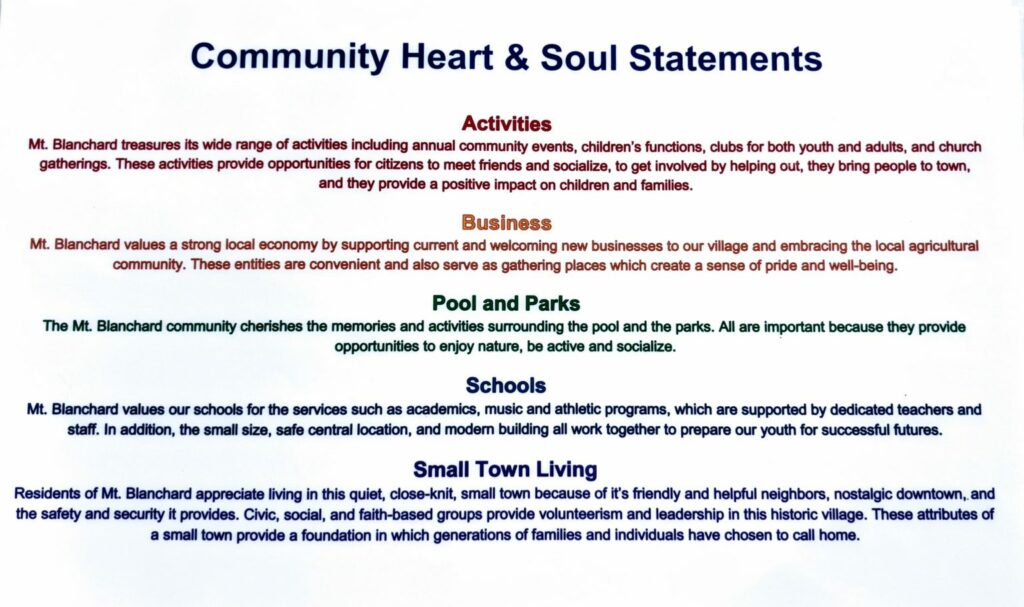
Listen to the people: The team collected stories from residents about what they valued about their town — a lot of stories — to reach consensus on residents’ core principles. These became guardrails for staying on track as they sorted through specific ideas for improvements.
Mount Blanchard CH&S Statements (Photo credit: Deborah Fallows)
Collect ideas for projects: Next, the team blanketed the town, hitting popular spots like the Hair Stop salon, the school, the restaurant, and the Corner Dairy Bar to record people’s suggestions. They set up a sticky-note board in town for people to add comments. They held porch parties, block parties, and a town hall party.
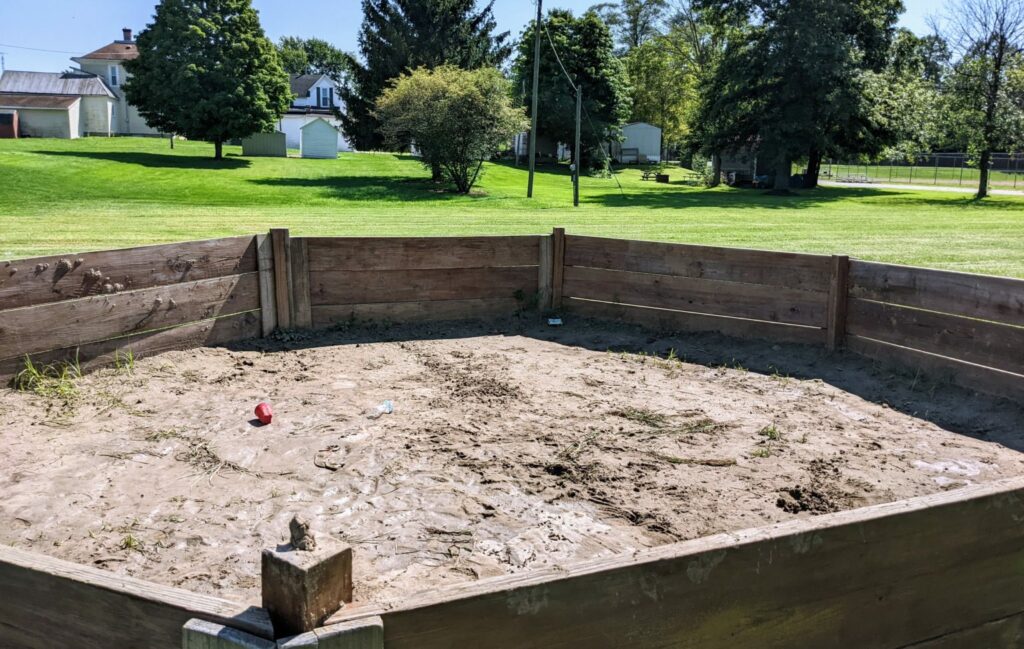
The suggestions were specific and wide-ranging. Older people suggested a community center and curbs along the road. Younger ones wanted mulch on the playground. The teenagers were eager for a gaga pit. Gaga pit? For those who are wondering or are uninformed — like we were — picture an octagonal sumo-like ring, with raised sides, a sandy base, and a gaggle of kids inside. Try to hit someone with a very soft ball. If you’re hit, you’re out. Last one standing wins. Repeat. Chaotic, dirty, and fun.
Gaga Pit in Mount Blanchard Island Park (Photo credit: Deborah Fallows)
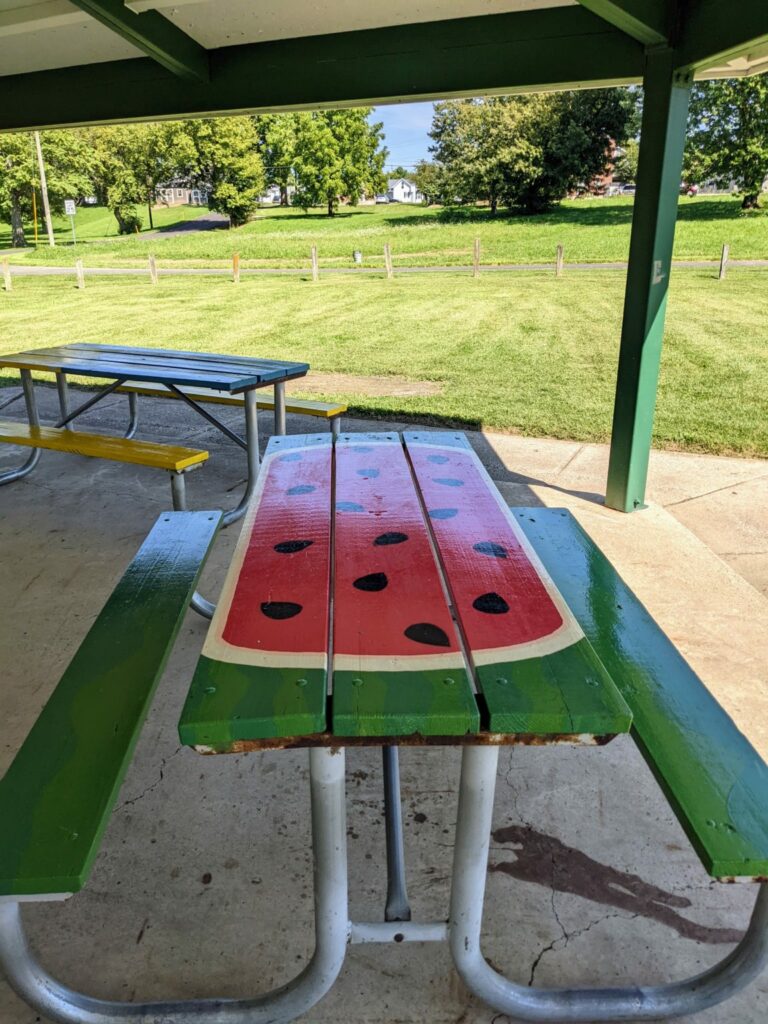
“We got some crazy ideas, like an international airport,” Jackie Porcello told me. And some skeptics’ grievances (“Yeah, we’ve heard this before; it’s never gonna happen.”). More attainable dreams came in, like festivals, a farmers market, covered areas with picnic tables or benches in the parks, striping the basketball courts, angled parking, a food pantry. All in all, the team logged every idea, more than 672 of them.
Picnic tables under the shelter in Mount Blanchard’s Island Park (Photo credit: Deborah Fallows)
In a series of wintertime meetings, fueled by home-made dinners, people sifted through, organized and narrowed down the suggestions.
Vote on the options: Considering practicality, costs, satisfying a lot of people, and compromise, Mount Blanchard residents went for some easy wins: Sports equipment, like balls and rackets, for the courts and fields. A BBQ grill, which came in handy at the back-to-school lunch for the kids. The gaga pit! The team gave money to the kids from Future Farmers (FFA) to purchase wood, and the kids built the gaga pit. The angled parking on Main Street. Lines for the basketball court. These were all small-but-big achievements for Mount Blanchard. And people noticed.
A long the way of Mount Blanchard’s evolution, many civic and volunteer groups stepped up to support one another. Enthusiasm was infectious, and one thing often led to another. New leaders emerged. Volunteers poured out for clean-ups. Festivals multiplied: a Pumpkin Festival, Christmas Village, a Bluegrass Festival, a Heritage Festival.
Mount Blanchard volunteers installing the LED digital sign in Hurricane Park (Photo credit: Jackie Porcello)
One particularly charming story stood out to me from our conversations with the residents: When volunteers were clearing out the fields by the swimming pool, lo and behold, they uncovered what had been a baseball diamond. One man recounted, “I went back home and looked at my wife. I said, ‘You know what, honey? As many times as we went down that street, it turns out there’s another diamond down there!’” That find led to a new old-timers local baseball team, who joined the Ohio Village Muffins, the mid-19th century version of baseball that is a regional tradition, played in vintage outfits by old-time rules.
From one big or small improvement to the next, the culture of the town was changing. People were getting to know their neighbors through participation. They knew whom to call in a pinch. Collaborations were building.
Here is how I would describe what I heard from the Mount Blanchard residents:
Pride in the town: When things began looking better, people took better care. Vandalism declined. Clean up days continued to draw scores of volunteers; kids showed up with brooms. Even private homes and businesses seemed to perk up; buildings were painted, old tires disappeared, trees were planted.
Communication and collaborations: For local information, people watched the LED sign. There were some nice surprises. “We had the idea to put to up more flagpoles in veterans park,“ one woman told me. “And when we were talking about doing that, another group that we hadn’t even heard of stepped up to say, Hey, we want to help.”
On the personal side, people from CH&S who interviewed their neighbors for stories, themselves saw their hometowns in a new way. Porcello told us one story from an elderly woman who talked of her fondness for hearing the church bells. “I never would have known things like this about residents I barely knew. It makes you feel differently about your town,” Porcello said.
A new imagination. People were inspired by each other to start new projects. The residents would profit, but so might the town. Maybe a pretty Main St. would attract visitors and tourists, who would support business. Maybe new parks would attract families and gatherings. Maybe people would surprise themselves and become leaders.
That’s the story of Mount Blanchard and how they practiced democracy. Many citizens in a small town working together to make small, and ultimately big changes.
Deborah Fallows
Deborah Fallows is a writer and a linguist. She has written for The Atlantic, National Geographic, Slate, The New York Times, The Washington Post, and The Washington Monthly. She is the author of three books including Our Towns: A 100,000 Mile Journey into the Heart of America (2018), a New York Times bestseller co-written with her husband, James Fallows. The HBO documentary, also called Our Towns, based on the book, is now streaming on HBO Max. Deborah and James founded the nonprofit Our Towns Civic Foundation to promote the ideas of resilience and renewal in towns across America.
In 2015, Dillsburg, Pennsylvania relocated the town’s library to a bigger space to better serve its growing population. A year later, when tragedy struck, the community stepped up to grow the library to include a reading garden.
Walking up to the public library in Dillsburg, Pennsylvania, I was struck that the building seemed greater than just a storage facility for books. The building and manicured two acres of land surrounding it felt like a center of gravity for the town.
Our Towns has repeatedly encountered and reported on libraries that serve as platforms for community engagement. But each library has its own history. I was curious to learn how this library came to be and what it means to the community in Dillsburg, a Community Heart & Soul® town we’ve reported on earlier here and here. (CH&S is a resident-driven community development process and is a partner and supporter of Our Towns reports.)
In Dillsburg, the story of the town’s library began in 1953. Several local women launched a story hour in the office of Dr. Martha Logan Bailey that eventually grew into the town’s public library. The original library changed locations several times until it landed in town on Baltimore Street, where it stood for 30 years in the building that is now Katapult Engineering.
But around the turn of the millennium, as Dillsburg’s economy began to shift from agriculture to services, Dillsburg’s population grew from just over 2,000 residents in 2000 to more than 2,600 by 2020. The library was running out of space on Baltimore Street, and attendance at events was down because of overcrowding. “We had heard feedback from residents that they would come through town, couldn’t find a parking spot, and they would continue on to the Mechanicsburg libraries,” Lisa Richardson, a local library board member, told me.
To keep residents in town, the local library board decided to make a change in 2015. A committee spent two years looking for a new location and finally settled on a former medical facility that was offered at a reduced price. Whereas the old space was a smaller, non-handicap-accessible office building, the new space is residential and accessible to all – and offers an open layout with plenty of parking.
The renovated space, which the town secured through a state grant, has helped the library accommodate a wide array of activities since the move, including events for residents of all ages. But children’s programming is a specialty. “Sue Rizzo, our youth services coordinator, does an unbelievable job with the kids,” Keith Greenawalt, Dillsburg Area Public Library Executive Director, told me. As we’ve written previously, librarians regularly tell us that children’s sections and activities are the most consequential segments of their work.
The library regularly hosts children’s performers and educational roadshows as well as monthly LEGO, Minecraft, and coding nights. “Our signature event this summer was an ‘escape room’ planned and assembled by teens in the community with Sue’s supervision,” Greenawalt said of the time-bound, puzzle-solving immersive experiences that have become popular nationwide. “We had 50 or 60 younger kids go through in small teams. It was nice to see an activity bring together kids of such a wide range of ages.”
Connecting teens with leadership opportunities to support programming for younger children is a strategy we’ve seen in many places, including Dodge City, Kansas.
In 2016, a tragic accident struck the community that would change the course of the library’s history. Lisa’s and John Richardson’s son and local Dillsburg resident Jordan Richardson died at 30 years old. In his memory, the Richardsons asked for donations to support the creation of a reading garden outside the library. “We were looking for ways to commemorate Jordan’s life and wanted to contribute to the community,” Lisa Richardson told me. “The garden was a perfect fit.”
An avid reader, Jordan could frequently be found with a book in his hand, his mother told me. When it wasn’t a book, it might’ve been his guitar – an instrument he taught himself how to play. And when he wasn’t reading or making music, he could be found exploring nature. “He took a cross-country road trip and made it to the Grand Canyon and Santa Barbara, California,” she said. “That experience shaped his life.”
These three areas of significance to Jordan offered the Richardsons a vision of a new space for the community – a garden that could bring reading, nature, and the arts into harmony.
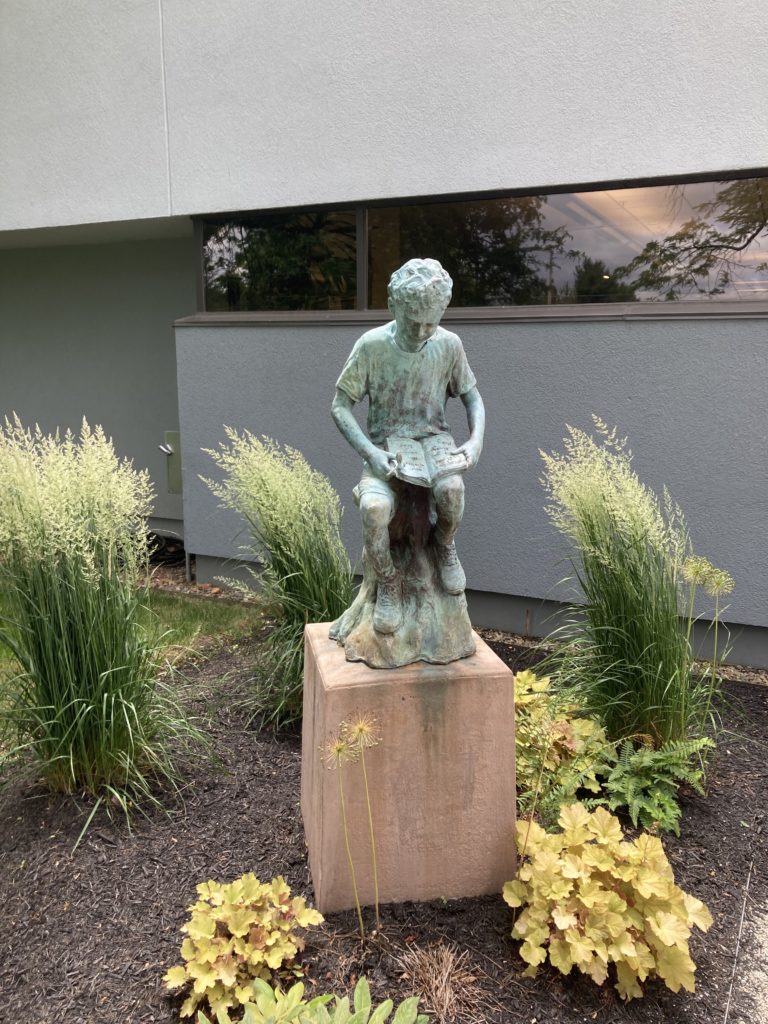
Chad Fischer’s sculpture in the Dillsburg Area Public Library Reading Garden. Photo by Jordan Sandman.
The Richardsons set to work and raised donations to turn that vision into a reality, including a substantial portion they matched themselves. Several community members contributed their talents in-kind. That included Rick Jackson, a local landscape architect and Jordan’s godfather, donated the design plans, and Chad Fischer, a nationally renowned sculptor, crafted a sculpture at a friends-and-family rate. The local gardening club installed the plants at no cost.
The community garden is naturally beautiful, but it’s also functional. Library staff use the garden to host outdoor reading time and a free concert series held monthly in the summer that attracts residents of all ages. The Dillsburg Public Library’s efforts are one of a long list of creative solutions that libraries across the country adopted to help their communities during the pandemic.
“The garden has been really important during Covid,” Greenawalt told me. “Since we were not able to be inside for some of our programming, the outdoor space has allowed us to spread out and continue operating. We had about 200 people for a program in July. There’s no way we could ever have fit that many people in the building.”
Dillsburg’s story is an example of how loss can lead to positive change. When the Dillsburg library began losing attendance, the board bet on the community by moving the library out of its decades-long home to gain a larger space to gather. When the Richardsons lost their son, the community gained a garden space to congregate to celebrate his life and delight in the things he loved.
As we previously reported, this is the ethos of Dillsburg – a place where residents put their energy into making their community a better place. Those efforts have paid off. Today, the garden and renovated space offers brings people together in celebration of nature, education, community, and the arts.
“I’ve had people email me saying they sit in the community garden to read, meditate, or just listen to the wind chimes and find peace,” Richardson told me. “We didn’t want Jordan’s death to be in vain.”
The Richardsons’ and broader community’s choice to convert loss into a celebration of community and life assures that it won’t be.
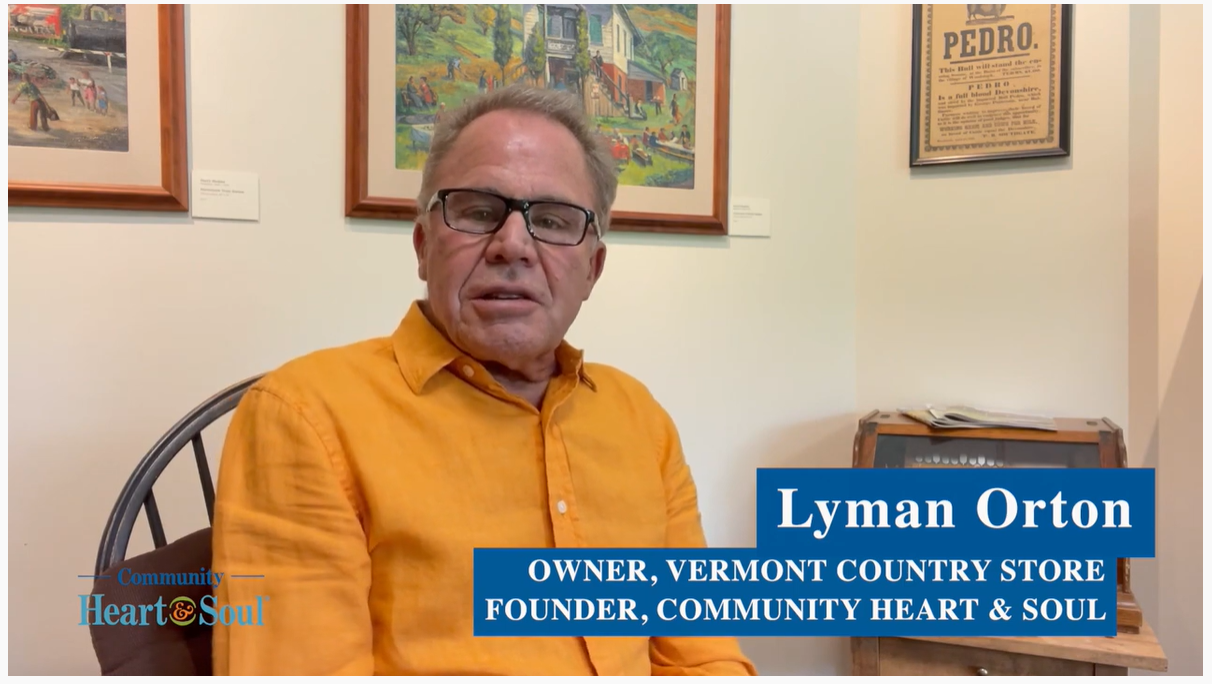
Hear from Lyman Orton, founder, as he reflects on his history and the origins and process of Community Heart & Soul®. Community Heart & Soul, a nonprofit organization, builds stronger, healthier, and more economically vibrant small cities and towns across the United States through the Community Heart & Soul model, a resident-driven process that engages the entire population of a town in identifying what they love most about their community, what future they want for it, and how to achieve it.
Who is Lyman Orton?
The Origin of Community Heart & Soul:
The Process of Community Heart & Soul:
View and subscribe to Community Heart & Soul on YouTube here.
The power of storytelling. The importance of civic engagement. The role of humanities in the 21st century, and how it has evolved over the years.
What happens when you getting off the bus to walk through a town and see things at the street level. Why youth engagement matters. What superwomen without capes can accomplish through partnerships and collaboration.
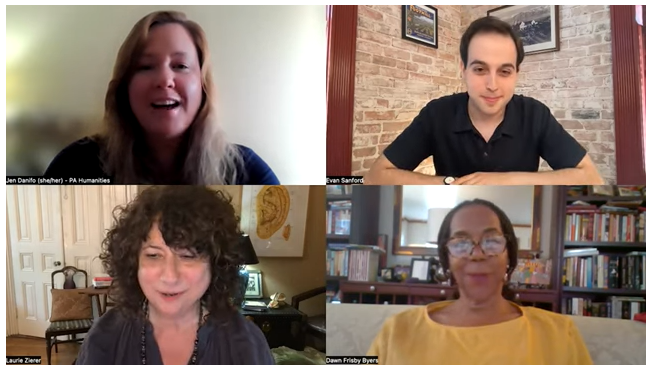
Those are some of the things you’ll hear about in this episode of the Inside Our Towns podcast. Host and producer Evan Sanford talks with Laurie Zierer, Dawn Frisby Byers, and Jen Danifo, all with PA Humanities, an independent nonprofit and official state and federal partner of the National Endowment for the Humanities, which was formed, along with the National Endowment for the Arts, in 1965 under the Johnson administration.
As Evan puts it, PA Humanities “brings Pennsylvanians together to shape the future through the power of stories, reflections and relationships. Their programs and brands put the humanities into action, generating avenues for civic involvement, community development, and personal growth.”
Some of those programs include the Teen Reading Lounge (an “award-winning, unconventional approach to book clubs that offer a safe space” for those ages 12 to 18, as the PA Humanities website explains here); and Chester Made (a “humanities-based initiative to celebrate and promote arts and culture and to harness their power as a force for community revitalization” that took place in Pennsylvania’s oldest city, Chester, as detailed here); and PA Heart & Soul (the council’s partnership with Community Heart & Soul®, a nationwide organization that supports local resident-driven community efforts, which is also a supporter of Our Towns), as noted here.
They also discuss the impact of the Covid-19 pandemic on humanities-based initiatives, and PA Humanities’ responses, including the new grant-making strategy, PA SHARP (Pennsylvania Sustaining the Humanities through the American Rescue Plan), a $1.4 million recovery and growth program.
You can watch their conversation here:
You can also listen on Spotify here:
We provide the Otter.ai-generated transcript below mainly as a guide to listening to, or watching, the actual discussion — and with awareness that it contains typos and will differ in some word-by-word details from what you may hear for yourself. The time-stamp numbers you see are roughly cued to the portions of the “Inside Our Towns” episode.
Inside Our Towns — Episode 2, featuring PA Humanities
SPEAKERS
Laurie Zierer, Evan Sanford, Jen Danifo, Dawn Frisby Byers
Evan Sanford 00:07
Hi there and welcome to this edition of Inside Our Towns. My name is Evan Sanford and I’m a contributor for the Our Towns Civic Foundation, and I’m the Executive Director at the Chamber of Commerce in Redlands, California. Today, our guests are with PA Humanities, which is an independent nonprofit and official state and federal partner of the National Endowment for the Humanities. The organization brings Pennsylvanians together to shape the future through the power of stories, reflections and relationships. Their programs and brands put the humanities into action, generating avenues for civic involvement, community development, and personal growth. And now it’s my very impressive guest today. Laurie Zierer, is an executive director at PA Humanities where she’s worked to strategically sharpened its focus on community building, education, advocacy, and research. During her tenure, she helped launch their three signature programs, which we’ll touch on in just a moment. Dawn Frisby Byers is their senior director of content and engagement. She’s a marketing executive with extensive experience in brand development and management, strategic partnerships, and both traditional and digital marketing. She recently led their rebranding and website redesign. And Jen Danifo is the organization’s Senior Program Officer and a certified level 2 Community Heart & Soul coach. She works closely with grantees to provide technical support in all aspects of public engagement, program development, learning and evaluation. We’ll get to much more of what each of them are working on in bear town later. But I’d like to welcome all of our guests to the program. Thank you so much. Thank you. Let’s start off with exactly what does the word humanities mean, in the 21st century? Laurie, how about you?
Laurie Zierer 01:56
Humanities in the 21st century, you know, at PA Humanities, a lot of folks talk about what we do as applied humanities. It’s taking the tools of the humanities, the practices of the humanities, for common good. Many times the humanities is defined as disciplines or content areas. And we easily you know, you know, literature philosophy, but we really think about the humanities as taking the books off the shelves and putting them in people’s hands to make changes in their community.
Evan Sanford 02:34
How has the work changed over the course of you know, the decades that you all have been involved? What has been some of the biggest changes?
Laurie Zierer 02:42
Well, you know, at PA Humanities, I think that we’re really a great representative of a state Humanities Council across the nation, there’s 56 of us in every state and territory. And we’ve been called an ongoing experiment. We’re over 50 years old, the endowments, the National Endowment for the Humanities and the Arts. They were created during the Johnson administration. And they were, the aim was, and it’s in the founding legislation that democracy demands wisdom. And for us at humanities councils that has meant something different in every state and territory of Pennsylvania, it means something that that it means in California where you are, or in Vermont, where the Community Heart & Soul was originally founded. And that’s an important part of the work, that we’re a nonprofit that responds to needs within the state and for us, big needs have been around education, particularly youth education, as well as in civic engagement in particular, engaging people across party lines to do and to do things together within their communities. I talked a lot about PA Humanities as a US finding our own identity and the state. And in during the economic downturn, we were faced with a fiscal crisis for us and how we were going to sustain ourselves. We have lost some funds from the National Endowment for the Humanities. We also lost all state funding we’ve never had. We’ve never been a line item in the Pennsylvania state budget, but we worked on through partnerships with state agencies and they had their budget slashed. So we really had to think about what was our relevance and Pennsylvania and we looked around and I colleges and universities, students were asking themselves Do I even want a liberal arts degree? What is that going to do for me in the market? placed, there was a, there was a real crisis in the humanities. And we said, Wait a minute, there is a real need, and really took a look at where we could make that difference with us with education and civic engagement. So I think that makes the big difference in the way that we really took our programs. And so with that start, we started to ask with the people of Pennsylvania, what was youth education going to look like? And what difference could it make, and we worked hand in hand with libraries, and with young people, to see what the kind of impact that our programs could have. And the the kind of impact was taking books, and identifying issues within the community to make a change, or with a program like heart and soul, to use stories in order to identify the values within a community and problem solve what that future would look like.
Evan Sanford 06:05
Dawn, let’s talk about that. And maybe Jen, you can follow up after that. How has your work been impacted by the pandemic? And also, how have you been working to do what Laurie was just talking about embracing humanity’s into the current, light and the current times and address those kinds of things,
Dawn Frisby Byers 06:24
the results of the pandemic, not withstanding the real reason for the pandemic, the health issues, but the pandemic offered an opportunity for us as a statewide organization to actually reach more people across the state. Up until then, our programs were primarily on the ground, one on one deep work, individual looks someone directly in the eye. But we but when that opportunity was taken away from us, we were able to take some of our learnings and some of and work with our partners to share information and create online programs, we were very quick to do that. And in back end, which allowed us to reach more Pennsylvanians, but more important for our message to get across to organizations, who now look at us in a different light. So I think we picked up some more fans. And we were able to illustrate how the what the humanities can do, and should be doing across various sectors, not just libraries, or just community groups, but throughout the state throughout the cultural sector of Pennsylvania. Jen, do you want to add?
Jen Danifo 07:57
Yeah, I mean, I think, you know, Dawn’s right, we probably have been more connected to some of our Pennsylvania’s a big state, it takes, you know, what, 767 hours to get for actually more than that, to get from one end to the other. So, you know, for a staff of 12, it is not always easy for us to go out and visit with people. The pandemic, of course, basically, you know, blew that off, we weren’t able to really go out, you know, no one was, so we had to pivot. And so I would say, in some ways, it actually, I know, because I work with the heart and soul communities, there are 10 right now that are currently running the program, three, of course, have kind of graduated on to like being done with the the actual process, but are still hard soul communities. You know, I felt like, I’ve gotten to know these people, because we’ve had like, weekly zoom calls. And, you know, people were just concerned, they were like, what do we do? And I also think, like, with are great. So you know, there’s a lot of talking about that, like, how do we do our work? Do we pause, I mean, a lot of people pause because they had to, you know, take care of personal, you know, issues a lot of people you know, it was just, it was just a little nutty at that time. But I will say the other thing, too, we have are sharp grants, the sustaining the humanities, through the American rescue plan act, we got some money through the federal government through the NIH in order to help organizations you know, recover and grow, you know, you know, from the impact of the pandemic and kind of recover from that and continue to grow. And it allowed us I think, the pandemic, in some ways asked us to slow down and listen to what they actually needed. We do programming and grant making and grant making can be this thing where you sometimes ask folks to like jump through hoops in order to get the money that they’re requesting. And I think for us, we really saw it as an opportunity, we needed to slow down and listen to them on what they needed. And in that way, we were able to kind of model the idea of the humanities, which is like, Let’s just not talk about the work, but talk about like what’s going on in your community. And so I think that was really valuable as well. And it’s something that even though like the pandemic kind of necessitated it. It’s something that we’re trying to weave into everything we do now. It’s like how do we understand the context of what people are working in and how the humanities actually supports that context.
Laurie Zierer 10:07
And Evan, you know, I just want I want to amplify it a point about the humanities, when we started on this journey to really think about what impact the humanities could have and a community, we were learning with folks. And we were told, as we went that these are really important tools, I never realized this, this would be so important to talk about race in my community. And right now, there is a realization in a different way that, you know, times are very complex, they’ve always been complex, but people are seeing it more than ever before. And how do I embrace this complexity? And that there are difference of opinions and perspectives and life experiences? How do we bring that all into the room and find what we can work together on with shared problem solving, that is the humanities. And folks are embracing the complexity. Because it’s not a simple narrative, when you get into a community about, you know, holding on to the past, and it used to be, oh, folks are holding on to the past. They’re looking to something that’s new, it’s more complex than that. And we’ve got to lean into the whole story and figure out what we can all chew on together and share and problem solve around.
Jen Danifo 11:34
Yeah, yeah. And I would say to that, you know, I think that’s a great point, Laurie. And I think that what we’re hearing from all of our communities is that this building this muscle of being able to discuss the context, and the complexity is something that I wouldn’t say is lost, but it’s not always practiced. Right. You know, if you think about the traditional humanities, or the traditional way, sometimes the humanities are employed. It’s, you know, thinking about dates and people and like all that’s important, but I think the idea of like, being able to someone just I heard someone talk, it was his historian, and he said, you know, history doesn’t necessarily repeat itself, because the context around the history is different. So each time something happens, even if it seems similar, like wars happened, but the context around the wars, always, there’s something different, right? Although there are patterns that you can kind of deduce from, you know, the past. And I think that that with our heart soul programs with our Chester made program with our teen reading launch program, even with our grantees, the relief and recovery programs, we’re hoping that people have the opportunity to dig into that complexity, because Laurie is right. I mean, the time is right for folks to be able to practice that muscle, it is not easy. But you know, every time we hear from our especially our heart and soul communities, thank you so much for giving us these tools. Because we would never have really talked about this had we not done heart and soul. Same thing with teen reading lounge, we hear that from libraries all the time, teens would never be able to talk about their identity in this way in a school setting, or at least it may not be as open. So that’s really, really important, I think. And one way we’re trying to go into the 21st century and make it a little more modern and applicable.
Evan Sanford 13:08
So Jen, you mentioned Community Heart & Soul. And listeners might remember that a previous guest in Iowa was a coach with Community Heart & Soul. And so I’d like to hear a little bit more about how that program is working in Pennsylvania and what you’re doing with the foundation itself.
Jen Danifo 13:25
For sure. So I will say, you know, we started this journey, I think it was about 2015 or 2016. Right? So it’s been quite a journey. We started with three communities. We we you know, like Laurie said, we decided that civic engagement was an area that we as a Humanities Council wanted to lean into, and explore. And so we, you know, discovered Community Heart & Soul, then they were called the Orton Family Foundation. And we reached out to them and we said, you know, storytelling is really a big part of the human like we see the humanities in this process, is there a way that we might be able to work together and see if we can bring this to Pennsylvania, for example, you’ll hear stories about how people really love the downtown because of all the recreation and were maybe back in the day, there were a lot of local businesses, and they want that to come back. So what does that tell us about what a community cares about and what the history of a community was, and then how we can maybe move forward and build on that. So it’s a really, really amazing process. And, you know, we work very closely with communities and really walk them through that process, their life experience becomes the text. You know, sometimes in the humanities, you think about like a text that you’re exploring their actual experiences, stories become that text that they’re, you know, kind of unpacking together and discussing together. And that creates a basis for a community action plan that goes beyond us. And you know, we’ll take them years and years, sometimes decades to implement.
Evan Sanford 14:47
Dawn, I’d like to ask you some something about how is this organization able to do the kinds of things that you’re all doing this does not seem like something that at least the three of you can accomplish on your Oh, what kind of partnerships do you have? And have you had over the course of so many years to ensure that you can actually accomplish all these amazing things that you’re doing?
Dawn Frisby Byers 15:11
Well, we are super women. So right there, you will just not wearing our capes today
Evan Sanford 15:19
was refusing.
Dawn Frisby Byers 15:22
But now it is a great question. But the this type of work can only exist. When we have on the ground partners no matter what, what what type of work we’re doing, we see on the ground partners, one stack is small and to the our our philosophy of working in communities means working with people who know the communities, the last thing we would do is come into a community and say, We’re the Humanities Council, and we’re here to help you, it’s you know, we don’t know what’s happening on the ground. So part of the discovery is what’s really going on here, good, bad, and, you know, and anything in between. And in order to be authentic in that work, you have to work with people who are trusted partners, who can help you navigate around certain certain situations. And also, who were who were there, were there before you came and will be there after we leave so so our partnerships, and our success is based a lot on who we work with, on the ground. And, and that they believe in what we’re doing, you know, and can help or at least help in the sense of help bring people together. For for their own good because we are one of our philosophies is people want are not problems to be solved. People come to people have assets everybody has has assets, and has something to contribute. We think people sometimes ask the wrong questions. So if you add if you come in and have invite people to share their stories, that’s when you really can get information and agreement and a new light, a new path will be will be revealed. You know,
Laurie Zierer 17:33
when we started this work, I remember way back when we embarked on a project that came to be known as Chester made, it was named by the community when it first started, it was called the downtown Chester corridor project. And we were invited in by the city of Chester, and local Weidner university to do some civic engagement kind of thing. They needed some town halls because they wanted to do. They had a grand idea to connect the downtown with the university and it was going to be an economic driver, and they knew that arts and culture had to be part of it. So couldn’t the PA Humanities come in, have a couple town halls, figure out what the community really wanted with arts and culture? We said, well, you know, we’re gonna have to do this a little bit differently, we’re gonna have to work with the community. And we all got together and whitener University put us all on a bus. And you could walk from whitener University to the downtown, but they put us on a bus to take us downtown. And there were some community members on the bus and we got very close to the downtown and community members turned to us. I remember this distinctly. And an artist said, I really think we should stop and get off the bus. And that’s the key, you got to stop and get off the bus to really engage with people. And we started to go into downtown stores. And I met an artist Devin walls, who was sitting in the back look and who the heck has come into town to look at us. Like we’re a problem to be solved. And we’ve been working behind the scenes here for a long time. And that’s when the conversation started. Because that’s an invitation for everyone to engage and sort out what the what we want to work on together and move it forward. It’s getting off the bus.
Evan Sanford 19:40
We in our previous conversation getting ready for today we we have talked about how you’re using mapping technologies to interact with other organizations that may not actually consider themselves to be humanities organizations. Talk to us a little bit more about what that looks like.
Dawn Frisby Byers 19:56
Sure. And to be clear, it’s more of a mapmaking project, it’s not so much technology we’re not. We’re not that savvy. But what
Evan Sanford 20:06
we are doing, don’t underestimate. That’s
Dawn Frisby Byers 20:09
right. That’s right. I forgot put my cake back on. Um, what? What we, what we’ve learned as we go throughout the state can speak with people, and particularly through our grant making efforts over the last two or three years, is that when you say, Are you a humanities organization? People say no. But then when you read what they do, you’re like, Yeah, you know, you are or you’re using humanities practice. Right. So we are doing a project in conjunction with Drexel University out of Philadelphia, their arts administration, department, to identify organizations throughout the state, who are using tools, humanity tools, like storytelling, and sharing, and reflection, and conversations, who are using these tools within their communities for for sharing, for community involvement, for community growth. And even though they don’t call it the humanities, we actually are calling the thing we don’t call it the humanities. So we are we are looking at developing a network of organizations who do this work, and have been doing it for years. So that we can illustrate again, how important this work is, and how, how it impacts this type of approach to work until like, so that we’re not the only ones carrying that banner.
Evan Sanford 21:55
Speaking of banners, is not here, great transition at Laurie, and Dawn, maybe you can also touch on this. Next year is going to be a banner year for you. It’s a big anniversary. So tell us what’s in store what’s what’s on tap for next year?
Dawn Frisby Byers 22:10
Well, it is our 50th anniversary is in 2023. And we have several things lined up. One is a bunch of research that we’ve done on these topics, one for team meeting, round one in community, heart and soul and several on this connections of other humanity like groups, we will be pushing those out, and probably do some programs around that. We have an idea to do a tour around the state where we will be very visible, hopefully with you know, COVID, never, never ending and never and always changing. But the idea is to take the PA Humanities on the tour and stuff in a lot of places, and, and show the power of storytelling in conversation by gathering people who are not like minded on the paper. But we all agree that people are more alike than they are different. And exercising and facilitating conversations like that. And then we have, we also will have a project that will illustrate the conversations and the works of Pennsylvania playwrights, particularly August Wilson, and his reflections of life in Pennsylvania in the 20th century. And we’ll use that to spark community conversation and dialogue
Laurie Zierer 23:57
as well. You know, I love the way that David White Pope, he puts it you know, every conversation is an invitation and our 50th year anniversary, there’s going to be a lot of conversations and really invitations to engage with the humanities and to you know, bring people together across what many people think our divides. We don’t see as many divides, we see a lot of commonalities, we see individual perspectives, and opportunities to bring people together to talk about what those differences are and how we can share to problem solve and work together on the future.
Evan Sanford 24:46
How can people find out a little bit more about the humanities?
Dawn Frisby Byers 24:50
Well, we have a brand new website, PA Humanities that org where our work is featured. There’s a also links to stories that we collect from our grantees, and also our program partners. We actually employ a part time storyteller who writes the stories for our, for our website, and also on the website are ways for people to get involved and to join us.
Evan Sanford 25:26
Well, I thank you all for joining all three super women. Thank you. Thank you. Thank you for being with us today. And for all of you that are joining us at home. Thank you for listening to this edition of Inside Our Towns.
This is the story of Elias Van Buren Parker, and how today’s telling of his story has the power to pull the town of Mt. Holly Springs, Pennsylvania from its early glory days, then decline, back to new days of glory.
This much is certain about Elias Van Buren Parker: He was born into slavery, in Virginia. He served with Union forces in the final year of the Civil War, as part of the 38th Infantry Regiment of the United States Colored Troops. And after post-war service that led to his honorable discharge from the military in New Orleans, he was determined to head north, as part of an African-American migration of people seeking work and a place to settle. One of his great-granddaughters, Janice Sweeney, says that according to family lore he was “told by his master to marry, start a family, build a church, and preach the word.”
However exactly he decided to begin the journey, Janice Sweeney’s summary accurately describes what he did. As he made his way north to Pennsylvania, Elias Parker walked over South Mountain, where the northern extension of the Blue Ridge finally lets go, to Mt. Holly Springs, Pennsylvania, about 25 miles north of Gettysburg. He married Lucinda Johnson, and they started what grew into generations of a large, sprawling family in the neighborhood of Mt. Holly Springs that the African Americans called Mt. Tabor. According to legend— and many of the stories of these parts and people in those times are inevitably legend rather than documented history—Parker was a carpenter and stone mason, using his skills to construct the Mt. Tabor African Methodist Episcopal Zion Church of pine cladding, logs, and stones. A metal hinge in the double-hung windows of the church is marked 1870, the best clue of when the church was probably constructed.
The small church buzzed as a place of worship and a hub of community activities. Mt. Holly Springs itself became a popular resort town, sought during the hot summer months by city folks, for its fresh air and amusements including a Ferris wheel, roller coaster, boating, restaurants, and more. Riding the trolley in from nearby Carlisle made the journey part of the fun.
Over the decades, more work opportunities beyond the Mt. Holly paper mill lured much of the congregation away from the town and the church. Then, the popularity of the family automobile lured many of the tourists off the trolley to other destinations. The church had a great run, but finally closed its door for good in 1970. Over the next 45 years, brush and vines completely engulfed the church. The memories of the services, the Sunday school, and the activities, began slipping away. Even today’s Mt. Holly Chief of Police, Tom Day, had thought that the church, barely visible from the street, was probably an outbuilding from someone’s farm, several people told me.
Mt. Tabor Church circa 1950s (Photo by Dorothy Hemphill, courtesy of the Cumberland County Historical Society).
My husband, Jim, and I travelled to Mt. Holly Springs – sometimes called Mt. Holly, sometimes just Holly, and sometimes by its formal name – as the trees were starting to leaf out. We were finally, and gratefully, resuming our travels for Our Towns after two years of mostly home-bound pandemic. We went to see the church and the cemetery across the street from it, part of a series of tours by the Mt. Tabor Preservation Project to tell the stories, spread the word, and hopefully, restore the church that is so fragile that many fear could simply fall apart and crumble to the ground.
The former Mt. Holly Theater, now the Center Stage Apartments on Baltimore Avenue
The stories of Mt. Holly have become the sinew that could connect the town, or borough, as it is officially designated, from its past glory days, through some recent decline, to a new version of thriving. As for the decline, it is evident from a quick stroll through downtown. One bookend of the historic main street, Baltimore Avenue, is dominated by a new Dollar General and a Sheetz mega-gas station. The old theater has been divvied up into a complex of apartments, which you could either describe as a loss of culture or as a promising example of repurposing, except for the eyesore display of individual utility meters displayed on the front of the building. Same for another church a few hundred feet up the street. The old houses and buildings, built right to the edge of the sidewalk, seem to serve as a kind of sound tunnel for the traffic that roars with a trail of unforgiving noise along Baltimore Avenue, which is a stretch of heavily-trafficked PA 34.
Parallel to Baltimore Avenue runs Mountain Creek, part of nature’s gift to the town and an early resort attraction. When I sat in a small park behind the Amelia S. Givin Free Library (that story to come soon), I watched a fisherman in waders casting hopefully into the currents around him. It was a step back to peace and serenity.
Baltimore Avenue in Mt. Holly Springs, where the houses are built right up to the sidewalks
Over the last decade, many concerned citizens in Mt. Holly have kicked into gear to address the changes in town. They organized a walking-tour audit of the town and wrote a to-do list. They formed a revitalization committee. They staged rallying events and cleanups. They hung banners along the main street, and some even manned brooms to sweep the streets when the town could afford to run their mobile sweeper only once a year. The new police chief got rid of 80 junked cars. Pam Still, a relentless activist with many community organizations and efforts, began to interview older residents and collect their stories of early Mt. Holly, lest they be lost. One story that had eluded Still was that of Harriett Gumby, a granddaughter of Elias Parker.
Collecting stories can be a hard business; it requires trust on both sides. Pam Still, who is white, knew she must earn trust from Gumby to ask for her story, which she did via an introduction and good word from Dr. Richard Gobin, the highly-regarded town pharmacist, who knew both Gumby and Still. At long last, Still went to meet Harriett Gumby along with Lindsay Varner, then a director at the Cumberland County Historical Society and the Greater Carlisle Community Heart & Soul ® (CH&S) organization, of which Mt. Holly Springs had become a partner. To help foster community renewal, CH&S begins with the belief that drawing out the stories of a town’s residents is the fundamental first step to teasing out the collective aims and making explicit positive changes in the community. (CH&S is a partner and supporter of Our Towns.) In the case of Mt. Holly, the Mt. Tabor church and the nearby cemetery are an example of how stories can take hold and lead to action.
Harriett Gumby told her own story, but even more adamantly she described the importance and central role of the Mt. Tabor Church in the overlooked history of the African American community of Mt. Holly Springs. While the history of the famous white people of the area are well documented, Varner told me, the official records of the African American community are not. There are a few recordings of births, marriages, and deaths, and a marking of the “colored” cemetery on a map. But little more. Still told me that as they talked, Gumby’s gaze kept returning to her back window and the barely-visible small building beyond, which was of course, the Mt. Tabor Church.
Inside the Mt. Tabor AME Zion Church, closed since 1970, but before the pews were taken out and stored for safety.
Gumby walked Still and Varner out beyond her backyard to the building, entangled in brush and poison ivy. Its door was nailed shut from the inside. Undeterred, Varner and a zoning officer who was with them, hoisted Still up through a broken window pane, over the hymnals, and onto a pew. “It was a time capsule,” Still told me, recounting when she tiptoed around inside.
The Mt. Tabor church was built with logs, stones, and pine planks.
Gumby’s stories caught on and became a reality and symbol of something the town could focus on. It could be both a piece of physical restoration and a recorded piece of history of the area that had long been left out of the telling. The effort took on a life of its own.
Carmen James, a former church congregant and now president of the Mt. Tabor Preservation Project, led 20 or so of us—mostly nearby residents who all seemed to know each other – around the church grounds and cemetery. We inspected the handiwork of Elias Parker and the layers of construction materials, which by now seemed held together by a prayer. We saw the holes from the woodpeckers that had had their way with the planks on the back wall of the church. We saw the doghouse where the black vultures, a protected species, had been enticed to set up nesting away from the attic of the church. Then we walked across the road to the “colored” cemetery, where a first wave of restoration was underway.
Carmen James and her life-size image of a USCT soldier at the Mt. Tabor Church Cemetery
James, who is the perfect storyteller, at once knowledgeable, heartfelt, funny, and humble, told us about the 50-some grave sites, pointing out the stones of Elias Parker and six other USCT veterans. We asked about his wife, Lucinda Johnson Parker, and heard that while she may be buried there, she may also be elsewhere, like in the Johnson family plot back near the church. No one is sure. We saw the solar lights planted in the ground over the spots that the penetrating ground radar survey, conducted by students at nearby Dickinson College, believed to be the locations of the unmarked graves. James also recounted that on the same day the scientific work searching for graves at the colored cemetery was underway, there was a wicking ceremony searching for graves at the Johnson family cemetery behind the church. That contrast caught our attention.
The cemetery near the Mt. Tabor Church, currently being restored and tended by the Mt. Tabor Preservation Project.
We heard about a recent Eagle Scout project, ending with an elegant wrought iron fence surrounding the graveyard. We learned that a cemetery flagpole will be installed in a matter of weeks. One of the two donors, a former military man, said, “Every veteran should have a flag flying over his grave,” quoted James.
We admired the before-and-after of the headstones in original and painstakingly-cleaned-up iterations. We heard the story of Danielle Ward-Smith, who had recently discovered the grave of her great-great-grandfather, USCT soldier Henry Ward, buried in the cemetery. Ward-Smith and her husband, who owns and drives trucks, volunteered to haul away and store the contents of the church for safe keeping until the restoration can be completed.
There is a long way to go. The church has made it onto the National Register of Historic Places, and design and engineering plans for the restoration have been drawn, but even a generous grant from Pennsylvania’s Department of Community and Economic Development didn’t meet the sole developer’s bid so far.
Harriett Gumby died a few months ago, short of seeing her dream of the church restoration fulfilled. She is not buried in the colored cemetery, but in the now-desegregated Mt. Holly Springs Cemetery across town. Burials in the colored cemetery are on hold, at least for now until the graves can be verified.
The church is a work in progress. When I asked Lindsay Varner how likely it was that the project will reach its goals, she told me, with no hesitation, “100 percent sure”. I asked Carmen James the same question, and she quoted Harriett Gumby, who used to say, “God’s hand is on this project.”
Deborah Fallows
Deborah Fallows is a writer and a linguist. She has written for The Atlantic, National Geographic, Slate, The New York Times, The Washington Post, and The Washington Monthly. She is the author of three books including Our Towns: A 100,000 Mile Journey into the Heart of America (2018), a New York Times bestseller co-written with her husband, James Fallows. The HBO documentary, also called Our Towns, based on the book, is now streaming on HBO Max. Deborah and James founded the nonprofit Our Towns Civic Foundation to promote the ideas of resilience and renewal in towns across America.
“Every town has a river walk, even if it doesn’t have a river.”
This has become a family mantra in our household since we began noticing so many busy and bucolic public walks and trails during our town travels. We found them following rivers or lakes, but sometimes tracking railbeds or winding through fields or parks or marshes.
In the U.S., the River Walk in San Antonio was the early favorite that probably inspired the trend. The idea of today’s San Antonio River Walk emerged from the response to a costly flood nearly 100 years ago. Plans for a dam, objections from a conservation group, and a vision for something altogether different – a river walk – carried on for almost two decades. WPA funding in 1939 propelled the project ahead, and it opened to the World’s Fair visitors in 1968.
River walks can drive tremendous economic returns, as is the case in San Antonio. Or they can focus more on healthy opportunities to keep residents moving or act as impromptu gathering places where old meet young, tourists meet natives, and residents who usually travel in different social and economic circles find each other eye to eye. River walks often celebrate the natural assets of an area, and offer anyone and everyone a chance to enjoy them.
Here are a few of my favorites: Seattle’s wetlands boardwalks. Greenville, South Carolina’s 22-mile Swamp Rabbit Trail along the Reedy River; the Capital Crescent Trail running between the C&O Canal and the Potomac River in our hometown of Washington, D.C.; the 29-mile hike and bike trail circling Sioux Falls; Redlands, California‘s Orange Blossom Trail, upgrading both the urban and undeveloped spaces; Duluth, Minnesota’s Lakewalk along the shores of Lake Superior; Danville, Virginia’s tree-canopied Riverwalk Trail along the Dan River. My list grows and grows.
When I caught up with our friends from Bucksport, Maine recently, one of my ambitions was to find out more about its river walk, the waterfront development called the Walkway, which we had first seen during a visit last summer to learn about the town’s ambitious citizen-led town development process called Community Heart & Soul ® (CH&S). (CH&S is a partner and supporter of Our Towns reports.)
Now, in the depths of winter and still wary of Covid, we settled on the next-best electronic and telephone exchanges to reconnect. I talked by phone with Nancy Minott, who was the original coordinator for the Community Heart & Soul efforts and is now a trustee of the Buck Memorial Library.
Talking through the items on Bucksport’s action plan for Community Heart & Soul, we were both amazed at how far the town had moved along and even beyond the list of improvements that they drew up a few years ago. Here are some: upgraded playground and public pool; transportation assistance to medical appointments for seniors; a creative matching-multiplier program to support local merchants; cooking classes; community gardens; new rental apartment development; history center and museum development; computer classes for seniors; street, sidewalk, and trail improvements; downtown beautification projects; wireless internet inside and outside the library. The list is still building.
View from Bucksport of the Penobscot Narrows Bridge and fort Knox (courtesy Judith Gillis)
Bucksport’s waterfront is a major natural asset, set along the shore where the Eastern Channel meets the mighty Penobscot River, with a view of the elegant Penobscot Narrows Bridge, flanked upstream by historic Fort Knox, which seems to grow right out of the steep hillside.
The Walkway runs the length of a good mile, just a stone’s throw downhill from Main Street. More than 20 years in the making, the Walkway already serves multiple purposes as a social gathering place, an economic stimulator, a healthy-living opportunity, an environmental improvement zone, a town beautifier, a record of history, a perspective on the town’s place on earth, a celebration of local identity, art, and creativity. But… and it’s a big but… at the far end of the Walkway looms the reminder of one of Bucksport’s biggest shocks and remaining challenges – the depression-era paper mill, described by the Ellsworth American in the winter of 1929-30 as – “one of the greatest industrial projects undertaken in the New England states in recent years.” The mill which opened in 1930, and long the economic core of the town, closed in 2014, taking away some 600 jobs and the flow-over economy. The theme of my previous piece was how the mill’s closure had become a catalyst for Bucksport’s current reinvention. The future of the mill property is another big upcoming event for the town.
First, the Walkway highlights.
Veterans Park on the Walkway (Deborah Fallows)
If you’re driving north along Coastal Route 1 and heading Down East, (directions around here are always a geographic trompe l’oeil for those of us “from away”) you’ll cross the Penobscot Narrows Bridge, and then the smaller East Channel Bridge. At its end and just below is Veterans Park, a kind of pedestrian gateway that was built in 2009, with a memorial and engraved stones.
Bucksport reminds residents and informs visitors of its more than 200-year history with a series of engraved plaques and granite benches honoring remarkable citizens or statements or events. Young Maine sculptor Matthew Foster created his granite work, Before the Wind, for the children and future generations of Bucksport. He writes in his artist’s statement, of its message for the children: “First, that they never dismiss their heritage, but instead return to it often; second, that the wind is always to their backs, propelling them forward, like a ship running before the wind.”
Before the Wind, by Matthew Foster and Whale, by Don Justin Meserve. (Courtesy Town of Bucksport.)
A second small yet powerful sculpture stands in its lee. This is Whale, by Don Justin Meserve, a celebrated Maine sculptor, who died a little more than a decade ago.
The Covid era is already marked by a granite bench from the Class of 2020 at Bucksport High School, engraved with the disarming and poignant words “Inspiration during Isolation.” I talked by phone with Jen Skala, who was the class of 2020’s adviser at the high school for their four years, about the back story of the bench.
Granite bench donated by the Class of 2020. (Deborah Fallows.)
During the simpler days of 2019, the class of 2020 had been busy raising funds in anticipation of their class trip to Boston, including their chosen highlights of a water park visit and a Red Sox game. They had raised enough money to cover all the costs for the 70-some class members. Then Covid hit, and the school doors slammed shut in March of 2020. Part of the collateral damage: trip canceled. The class huddled and (magnanimously) decided to use part of the funds to give back to the community of Bucksport, which had generously supported them in their fundraising efforts and at school events. The class noticed the model of the Class of 1950 and their granite bench along the Walkway. Now, 70 years later, there would be another, marking a heavy moment in the town’s history and lasting for the ages. The class did more, creating two $500 scholarships for classes that would follow them, for students to pursue any kind of continuing education, be it community college, trade schools, or four-year college.
For recreation and commerce, Bucksport built out the Town Marina’s access to boats, added a diesel fuel pump, began to rebuild its floating docks, and replaced its fishing pier. Plans for a year-round dock structure with handicapped accessibility are in the works.
American Cruise Lines’ American Constitution docks in Bucksport. (Courtesy of Judith Gillis)
The American Cruise Lines has included Bucksport as a port of call for its passenger ships. And Bucksport is approaching the Pan Am Railways System (soon to be part of CSX) about securing the unused properties at the end of their Bucksport Branch for new business and commercial expansion. On a personal scale, as of 2021, vendors were granted permits, scaling up festivals and gatherings, like the Bucksport Arts Festival, Ghoulsport, the Penobscot Maritime Heritage Event, and Bucksport Pride.
Picnic Point along the Walkway, paper mill in the background. (Courtesy Hans Krichels)
Set in an observation lookout of the Walkway, Picnic Point is a five-panel story panorama of Bucksport’s history. The offset‘s 10-foot diameter compass rose is laid in the bricks, and in its center, reinforcing Bucksport’s plucky, self-aware, colloquial identifier as “Center of the Known Universe” is a tall pole with directional arrows: Cairo – 5200 miles away, Moscow – 4300, and Albany, Australia – 11,675. There are fountains and picnic benches, plenty of summer flowers, and a gazebo all along the path.
Along the Story Walk in Bucksport. (Courtesy of Hans Krichels)
My favorite section of the Walkway for people engagement is the Story Walk and the accompanying exercise prompts. In 2018, the Buck Memorial Library volunteers installed the first of its rotating series to celebrate favorite children’s books with illustrated pages mounted on signposts. Beneath the book pages, more signs encourage children to Take Baby Steps, Skip, Gallop like a Horse, and Walk like a Duck.
Approaching the western end of the Walkway, I was hoping to find my way to a closer view of the old paper mill. It is hard to imagine the former bustling life and work inside and around the mill. I corresponded with Sue Lessard, Bucksport’s indefatigable town manager, to guide me into the future of what might happen with the old mill. It turns out: plenty.
The mill and its properties, having gone through a series of changes and acquisitions since its closure in 2014, are now divvied into ownership by three different companies. Whole Oceans, a land-based producer of farm-raised salmon, retains a permit until the end of 2023 for a “recirculating aquaculture system” to grow an annual 5000 metric tons of salmon. Announcements are forthcoming. The Maine Maritime Academy, up the road in Castine, has a Mariner Training Institute up and running. They are planning expansions. Ironclad Energy, a company that deals in power generating properties, bought the plant’s backup power generating facility.
At the end of our book, Our Towns, Jim wrote about the “10 1/2 signs of civic success” that we saw and learned about from the successful towns we visited. I think it is probably time to update that list, to add River Walk and make it 11 1/2 signs.
Deborah (author) and James Fallows in Bucksport, Maine
James and Deborah Fallows, authors of Our Towns: A 100,000-Mile Journey into the Heart of America, spent five years crisscrossing the country in their single-engine plane, visiting dozens of small cities and towns. Wherever they touched down, they would interview local residents, town officials, business owners, librarians, and others to learn how communities were reinventing themselves in the face of changing economic and social conditions.
Our Towns became a national best seller and was recently made into a feature-length HBO documentary film. The Fallowses also launched Our Towns Civic Foundation, a nonprofit organization that serves as a platform for sharing stories of small-town innovation and resiliency. Through the foundation, they connect and support individuals across America who are working to improve local communities.
The Fallowses also launched Our Towns Civic Foundation, a nonprofit organization that serves as a platform for sharing stories of small-town innovation and resiliency. Through the foundation, they connect and support individuals across America who are working to improve local communities.